.png?width=14&height=14&name=Icon%20(1).png)


.png?width=24&name=Group%20(3).png)


%201.svg)


.svg)

.svg)



















How Can We Help Your Business?
Select a service below and our experts will
reach out to you within 24 Hrs.
 No commitment
 30 minutes
 100% free
According to HubSpot's State of AI report, 91% of marketing leaders say that their teams use AI in daily work and 82% of marketers report that they’ve invested in automation tools to streamline their marketing workflows.
Needless to say, traditional marketing has evolved a lot with tools like automation and Artificial Intelligence (AI). But many businesses are still catching up on this advancement and they often confuse terms like AI marketing and automated marketing.
In this marketing guide by MarkeStac, we’ll discuss how marketing and the latest approaches of marketing automation and AI marketing work and how businesses can use them together for scalable growth. Let’s start this blog with the basics of marketing.
What Is Marketing?
Marketing is an age-old process of promoting your products or services to attract potential customers, engage them with meaningful content, and convert them at the right time.
From selling mass-produced goods, marketing evolved to create personalized customer journeys through channels like content marketing, SEO, email marketing, and social media marketing.
The Core Components of Marketing
While every business has its own marketing strategies, most campaigns are built on the same foundational elements. These core components of marketing are:
- Market Research
Understanding who your target audience and competitors are, and analyzing industry trends to create relevant products and marketing campaigns.
- Segmenting Customers
Segmenting customer groups on the basis of their demographics, interests, purchase history, or engagement for better personalized targeting.
- Brand Positioning
Designing a unique brand identity that sets you apart from other brands in the mind of your potential customers.
- Content Marketing
Creating blogs, videos, guides, webinars, and case studies to educate prospects and build trust and authority.
- Search Engine Optimization (SEO)
Improving your search visibility so that customers discover your brand organically when they're looking for solutions.
- Answer Engine Optimization (AEO)
Structuring your online content so that your brand ranks in AI-generated answers on ChatGPT, Perplexity, and Gemini.
- Lead Generation
Attracting potential customers and encouraging them to take meaningful actions, such as downloading a guide, requesting a demo, or subscribing to your newsletter.
- Email Marketing
Nurturing your leads by sharing valuable content, and maintaining long-term relationships with customers.
- Performance Tracking
Measuring your campaigns against meaningful metrics such as website traffic, conversion rates, customer acquisition costs, and ROI for optimizing them.
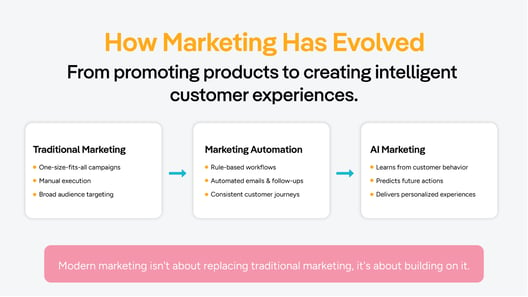
Is Traditional Marketing still Relevant Today
While the rise of new tools like AI and automation has transformed how marketing works, making it more efficient and scalable, the traditional marketing principles are still as important as ever.
These tech tools speed up the execution of your campaigns and improve your decision-making but they cannot replace the value of a clear strategy and understanding of your target audience.
Think of marketing as the foundation of your house. Any add-ons like AI and automation can only work successfully if they are built upon a solid foundation.
What Is Automated Marketing?
As a business grows, marketers have to spend most of their time on repetitive tasks like sending follow-up emails, assigning leads, and managing customer journeys manually. This gave rise to marketing automation which uses software tools to execute these repetitive activities.
Automation ensures that the right actions happen automatically whenever the conditions that you’ve specified are met. For example, if a visitor downloads an e-book from your website, your marketing automation platform will instantly send a thank-you email and add this contact to an email nurturing campaign.
The best part is that you only need to design this workflow once and the automation system will execute it consistently every time.
How Does Automated Marketing Work
Marketing automation works through workflows that begin with a customer action called the trigger. It could be downloading an e-book, filling out a contact form, or visiting a pricing page.
Once this trigger occurs, the marketing automation platform executes the corresponding workflow automatically by evaluating your predefined rules.
For example - When a prospect downloads a buying guide (Trigger), a lead nurturing sequence would begin, starting with a welcome email. Followed by sharing a relevant case study, three days later. If this prospect clicks on your pricing page, your CRM will be automatically updated and the sales team will be notified.
What Marketing Tasks Can be Automated?
Modern marketing automation platforms can streamline almost every repetitive task of the marketing process.
You can automate tasks like:
- Email Marketing - sending welcome emails, newsletters, promotional campaigns, and drip sequences automatically based on customer behavior.
- Lead Nurturing - sending educational content customized to the prospect’s stage in the sales funnel.
- Contact Segmentation - organizing contacts automatically into lists based on their demographics, interests, website activity, or purchase behavior.
- CRM updates - creating or updating CRM contact records automatically without any manual data entry.
- Lead Assignment - routing qualified leads to the appropriate sales rep based on predefined criteria like location, product interest, or company size.
- Customer Onboarding - delivering onboarding emails, tutorials, training resources, and checklists after the customer makes a purchase.
- Reporting and Notifications - creating performance reports and notifying your internal teams whenever an important customer action occurs.
All this helps marketers so that they spend less time on managing admin work and get more time to focus on strategy, creativity, and customer engagement.
Benefits of Marketing Automation
Marketing automation doesn’t simply save your time but also creates consistent processes. This improves the customer experience and increases your operational efficiency as your business grows.
Some of the biggest benefits of automated marketing include:
- It saves time by automating routine marketing activities so teams can focus on higher-value initiatives.
- It reduces manual errors like missed follow-ups, duplicate records, inconsistent messaging, or forgetting tasks.
- It improves lead nurturing through timely, relevant communications based on their actions instead of generic campaigns.
- It increases productivity of marketing and sales teams as they spend less time on admin work and more on building relationships, creating campaigns, and closing deals.
- It delivers consistent customer experiences no matter if your business generates ten leads per week or ten thousand.
- It supports business growth by scaling as you grow so you don’t have to increase your headcount.
Investing in a marketing automation tool is only the first step. Its real value comes from designing workflows that reflect how your customers research, evaluate, and buy. Marketing automation agencies like MarkeStac help organizations to build smart strategies that align their marketing, sales, and CRM systems so they are better prepared to grow.

What Is AI Marketing?
You know that marketing automation focuses on executing tasks efficiently, AI marketing adds a layer of intelligence to this. As businesses today collect huge amounts of customer data through website, CRM, email campaigns, and social media, AI helps them to gain actionable insights from this data.
AI models analyze your customer interactions and identify patterns from them to predict outcomes and recommend the next course of actions to improve your marketing performance. This allows your marketing teams to make faster, more informed decisions without analyzing thousands of records manually.
How Does AI Marketing Work
AI marketing combines several technologies to analyze your data and optimize your marketing activities. Let’s go over some common concepts related to this:
-
Machine Learning
Machine learning enables AI systems to continuously learn from your historical data and improve their predictions without being reprogrammed every time. For example, an AI platform may learn over time that leads from a particular industry who visit your pricing page twice and download a case study are more likely to request a demo.
-
Predictive Analytics
Predictive analytics is closely related to machine learning, it uses historical customer data to forecast future behaviors like which prospects are most likely to purchase or which customers may be at risk of leaving. This helps your sales team to prioritize high-value opportunities instead of treating every lead the same way.
-
Natural Language Processing (NLP)
Natural Language Processing allows AI to understand and generate human language. This is how powerful AI features like AI chatbots, content recommendations, email writing assistance, and conversational search work.
-
Customer Behavior Analysis
AI continuously monitors how visitors interact with your website, emails, ads, and content to identify their engagement patterns and buying intent. You can also utilize these buyer intent signals through the HubSpot CMS for better, targeted intent-based marketing.
-
Data Modeling
By connecting data from multiple channels, AI creates a complete picture of the customer journey. This helps your teams to identify patterns that would otherwise be difficult to detect manually.
Together, these technologies help businesses to stop reacting and make proactive, data-driven decisions.
Example Use Cases of AI Marketing
AI has already become an integral part of many marketing platforms. This has made advanced capabilities accessible to not only enterprises but businesses of all sizes
Some common applications of AI marketing include:
-
AI-Powered Chatbots
These modern chatbots can answer customer questions, qualify leads, recommend products, and schedule meetings even when your team’s off work. This improves both customer experience and your response times.
-
Predictive Lead Scoring
Instead of manually qualifying leads, AI evaluates the customer behavior and engagement patterns to identify which leads are most likely to convert.
-
Personalized Recommendations
AI can create a more relevant website experience by recommending blogs, products, or resources based on a visitor's interests and their browsing history..
-
Email Optimization
AI helps email optimization by suggesting subject lines, the best time to send emails, and personalizing messaging for different audience segments, improving their engagement.
-
Dynamic Website Personalization
Instead of showing the same homepage to every visitor, AI can customize your content, CTAs (calls-to-action), and product recommendations based on user behavior.
-
Advertising Optimization
AI continuously analyzes your campaign performance and uses this data to adjust your targeted audience and budget allocation to improve your ROAS (return on ad spend).
Benefits of AI Marketing
AI isn’t just an emerging technology today but the reality of most businesses. From enterprise businesses to mid-sized companies and startups, AI has enabled businesses of all sizes to make smarter decisions without increasing their headcount.
Here’s a list of benefits that businesses often gain from using AI for their marketing operations:
-
Better personalization
AI helps businesses to deliver personalized recommendations, emails, and website content based on individual customer behavior rather than targeting groups.
-
Faster decision-making
Instead of manually reviewing each and every campaign report, marketers can use AI to analyze their large volumes of customer data and get meaningful insights from it.
-
Better lead quality
By identifying high-intent prospects earlier in the buying journey, AI helps marketing and sales teams to focus on opportunities that have the highest chances of conversion.
-
Improves campaign performance
AI continuously evaluates how campaigns are performing and recommends optimizations to refine strategies based on real-time data and not assumptions.
-
Promotes scalable growth
As a business grows, its customer data becomes more complex. AI helps these growing businesses to maintain personalized experiences without increasing their marketing resources.
How Does AI Improve Lead Generation
Lead generation isn’t just about filling more forms. The real challenge is to identify which leads are genuinely interested and the best way to engage them. This is where the role of AI becomes more valuable.
With the help of AI, you can:
- Identify your high-intent prospects based on their online behavior.
- Predict which leads are most likely to convert.
- Automatically score leads using multiple engagement signals.
- Recommend the next best action for your marketing and sales team.
- Personalize customer interactions across marketing channels.
For marketing teams, this means they spend less time on qualifying their leads manually and more on creating campaigns that drive meaningful engagement.
How Does AI Help Sales Teams
For the sales teams, AI supports sales automation by helping reps to focus on the opportunities that are most likely to close.
AI helps here to :
- Predict deal outcomes based on your historical data.
- Recommend the best follow-up actions for individual prospects.
- Prioritize sales opportunities according to the buyer’s intent.
- Analyze customer conversations to gain valuable insights.
- Improve your revenue forecasting.
AI doesn’t replace sales professionals but helps them spend more time on building relationships and less time deciding where to focus their efforts.
Businesses expect immediate results from AI tools but their disconnected systems and inconsistent CRM data often limit the effectiveness of these tools. At MarkeStac, we help businesses to integrate AI with their marketing automation and CRM platforms so that everything works together to support scalable growth.
AI Marketing vs Automated Marketing: What's the Difference?
Automated marketing and AI marketing are two different approaches. Automation acts on pre-defined rules to improve your efficiency while AI utilizes behavioral insights to optimize your marketing strategies.
Which Is Better: AI Marketing or Automated Marketing?
When it comes to comparing AI marketing and marketing automation, one isn’t better than the other. Growing businesses benefit the most when they use AI and automation together.
Marketing automation provides the operational efficiency to execute marketing campaigns consistently, while AI offers the intelligence to improve these campaigns over time. When used together, businesses get better ROI and conversion rates.
How AI and Automated Marketing Work Together
Automated marketing and AI work together to create a connected customer journey offering hyper-personalized interactions. With AI and automation, a typical customer journey might look like this:
- A visitor downloads a guide from your website.
- AI analyzes this visitor's engagement pattern and assigns a lead score based on this.
- Marketing automation then enrolls this lead in a personalized nurture campaign.
- AI monitors his engagement and predicts purchase intent.
- Once the lead reaches a predefined threshold, your sales reps receive an automatic notification.
- AI recommends the most effective follow-up based on previous customer interactions.
This workflow is a clear example of how AI and automation create a connected marketing and sales process that is both efficient and data-driven.
Can AI and Automation Increase Revenue
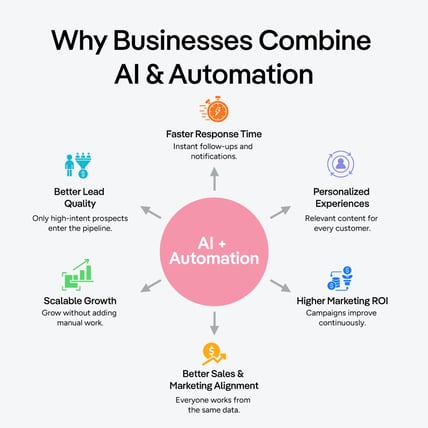
From our previous discussion it’s clear that AI and automation work better together and can improve your revenue. It helps your teams to work smarter at every stage of the customer journey.
The benefits of AI and marketing automation working together, include:
- Only the highest quality of leads enter your sales pipeline.
- Faster response times to customer inquiries.
- You engage customers better with hyper-personalized experiences.
- As the manual work decreases your sales productivity improves.
- Your marketing ROI increases through optimized campaigns.
This also improves marketing and sales alignment so your teams can focus on strategy, relationship-building, and growth initiatives that have the greatest business impact.
Can Small Businesses Use AI and Marketing Automation
A common misconception that most businesses have is that AI marketing is only practical for large enterprises with extensive budgets. In reality, many modern CRM and marketing platforms now include built-in AI capabilities that are beneficial for startups and growing teams too.
These AI capabilities include:
- AI content assistance
- Predictive lead scoring
- Email optimization
- Customer insights
- Automated reporting
But this doesn’t mean that you should adopt every new technology. Start with simple marketing automation workflows and gradually introduce AI capabilities as your customer data and marketing operations mature.
You can also check our guide on HubSpot marketing automation workflows to understand how you can build scalable marketing workflows.
How to Choose the Right Marketing Automation Tool
When it comes to selecting a marketing automation tool, you shouldn’t just pick one that’s trending but evaluate how this platform will work for your business.
Here’s a step-by-step guide to help you choose the right automation tool:
- Start with an assessment of your current setup - Identify the shortcomings of the automation tool you’re using currently. If you’re not using one, document how your current workflow could be improved with automation.
- Define your automation goals - Define measurable goals that you want the automation tool to achieve for your business.
- Review integration support - Evaluate whether the automation platform offers integration with other tools in your tech stack.
- Compare pricing and scalability - Check whether the platform offers per contact charges or flat charges and offers scalability.
You can also check out our guide on AI-powered marketing automation tools to learn which tools you can use to combine the benefits of AI and automation.
How Marketing Will Change in the Future
Marketing is shifting drastically with the launch of new tech tools. The current shift has led marketing from manual execution to AI-driven systems that are intelligent, connected, and customer-centric.
This shift has also transformed the role of marketers, with the automation of their routine tasks, marketers are now becoming strategists who use data-driven insights to design successful campaigns.
Businesses are already using AI for personalization, creating predictive customer journeys, automating content recommendations, and creating unified workflows for marketing and sales.
The companies that will gain a competitive advantage in this era of marketing won't be those who have simply adopted AI or automation. But the ones who are integrating these tech tools into a well-defined customer journey supported by their strong marketing fundamentals.
To support this transformation, MarkeStac has curated the best CRM software AI tools to help businesses build smarter, more connected marketing systems.
Why Work with a Marketing Automation Agency?
Many businesses purchase powerful marketing automation platforms but struggle to realize their full value due to their disconnected CRM systems, inefficient workflows, and underutilized AI capabilities. Working with a marketing automation agency helps businesses by bridging the gap between software and strategy.
At MarkeStac, we help businesses design and implement connected marketing systems, bringing marketing automation, AI, CRM, and sales processes into one scalable growth system.
From mapping your customer journeys and designing automated workflows to CRM integration, we help businesses automate with purpose and not simply to boost their efficiency.
Takeaway
Marketing has evolved over the years with traditional marketing building the foundation by understanding customers and creating compelling messaging. Marketing automation adds to this by executing campaigns efficiently and reducing manual efforts. While AI marketing adds intelligence to analyze data, predict customer behavior, and optimize your campaigns in real time.
When these three work together, you create a better connected journey for customers. You attract the right audience to nurture leads with personalized messaging and support your sales to build lasting customer relationships.
At MarkeStac, we help businesses to combine strategy, automation, and AI into their marketing systems and drive measurable, sustainable growth. Contact us to get started.
Frequently Asked Questions
Got questions? We’ve got answers. Explore the most common queries about Markestac's automation platform and learn how it can streamline your processes, connect your tools, and drive growth.
Is AI replacing marketing?


No, AI is not replacing marketing. It is rather enhancing the traditional marketing strategies by improving decision-making and efficiency of marketers.
Is marketing automation worth it for small businesses?
Yes, marketing automation is extremely beneficial for small businesses. It helps these small teams to scale their operations without increasing their headcount.
What is the difference between marketing automation and sales automation?
Marketing automation focuses on automation tasks related to lead generation and nurturing, while sales automation focuses on managing and accelerating sales processes.
Can AI improve marketing automation?
Yes, AI can improve marketing automation through smarter lead scoring, content personalization, customer segmentation, and campaign optimization.
Do I need both AI Marketing and Marketing Automation?
Yes, most growing businesses need both AI marketing and marketing automation for scalable business growth. They work well together as AI provides the intelligence, while automation supports efficient execution of marketing campaigns.
.jpg)





.png?width=80&height=81&name=mail-01%20(1).png)


.svg)



.png?width=410&height=126&name=Group%201000005667%20(1).png)