




















Go-To-Market-Consulting
"Targeted Outreach, Measurable Growth"

Go-To-Market Strategy
Stop guessing your way to market. Launch on a system.
We build the go-to-market strategy behind your revenue the ICP, the offer, the channels and the sales motion then wire the tool stack that actually runs it inside your CRM.

400+
98%
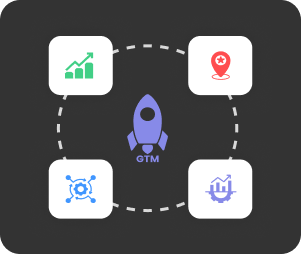
The GTM engine, in four layers
Market & ICP
Offer & positioning
Channels & sales motion
Systems & measurement
What is a go-to-market strategy?
A go-to-market (GTM) strategy is the documented plan for how you take an offer to a specific market and convert it into repeatable revenue: who you sell to, what you say, where you reach them, how the deal is worked, and which system records every step.
It is not a marketing campaign and not a launch date. It is the operating agreement between marketing, sales and service written down, instrumented in your CRM, and reviewed against numbers.
A GTM strategy answers
A GTM strategy is not
The case for it
Why Your Business Needs One
Most revenue problems are not effort problems. They are GTM problems the team is busy, but nobody agrees on who the buyer is or what happens next.
Budget burns on the wrong audience
Leads leak between teams
Sales and marketing tell different stories
Forecasting is a feeling
Tools stack up without talking
Growth stops when a person leaves
Where it applies
Where You Need Go-To-Market Strategy In Your Business
chance. Here is what each one means and what it produces.
Automated inbound
Every form fill, chat and demo request is captured, qualified, routed and followed up without anyone touching it manually.
Produces: sub-5-minute speed-to-lead, zero dropped enquiries.
Account research
Structured intelligence on each target account org chart, tech stack, funding, triggers gathered before a rep ever writes an email.
Produces: pre-call briefs and relevant first lines at scale.
ABM
Account-based marketing: a named list of high-value accounts worked as a market of one, with marketing and sales hitting the same buying committee together.
Produces: larger deals, multi-threaded and coordinated.
PLG assistance
Product-Led Growth support: product usage becomes a signal, so sales steps in exactly when a free or trial user shows buying behaviour.
Produces: PQL scoring and self-serve to sales-assist handoffs.
Rep assistance
The system does the admin: next-step reminders, drafted follow-ups, call summaries, auto-logged activity and playbook prompts inside the deal record.
Produces: more selling hours per rep, cleaner CRM data.
Reverse ETL
Decision support: warehouse and product data pushed back into the CRM and ad platforms, so the numbers live where the team works not in a BI tab nobody opens.
Produces: one source of truth for revenue decisions.
Outbound
Deliberate, signal-based prospecting: tight lists, sequenced multi-channel touches, tested messaging and disciplined follow-up not spray and pray.
Produces: pipeline you can create on demand.
CRM enrichment
Records completed and kept current automatically firmographics, roles, technographics, deduplication and consistent field standards.
Produces: segmentation and reporting you can trust.
TAM sourcing
Total Addressable Market, built as a real list: every account that could buy, sized and segmented into serviceable and immediately winnable tiers.
Produces: territory plans and defensible growth targets.
Not sure which of the nine you are missing?
Early advantage
Benefits Of Applying GTM At The Early Stage
The earlier the strategy exists, the cheaper every correction is. Fixing positioning at month two
costs a workshop; fixing it at month twenty costs a rebuild.
FOCUS
One segment, not ten
SPEED
Faster time to first revenue
EFFICIENCY
Lower cost per acquisition
DATA
A clean baseline from day one
SCALE
Hiring onto a system
CREDIBILITY
Investor-ready numbers
Horizon
The Long-Term Goal Of A GTM Strategy
0–90 DAYS
Validated motion
6 MONTHS
Predictable pipeline
12 MONTHS
Efficient growth
24 MONTHS +
Market position
Early advantage
The GTM Tool Stack We Work In
Tools do not create strategy, they execute it. Each layer below has one job, and every layer writes back to the CRM.
Data & Targeting
DataBuild the target list: firmographic and technographic filters, verified contacts, sequencing for first-touch outbound.
Enrichment & Signals
EnrichmentWaterfall enrichment and signal scraping hiring, funding, tech changes turned into scored, personalised lists.
Sales Navigator
RelationshipsBuying-committee mapping, warm-path discovery and social touches that make cold outreach less cold.
CRM
Source of truthOne record per company and one owner per stage. Every tool writes back here, so reporting comes from a single source.
AI layer
LeverageResearch briefs, message drafts and call summaries generated from CRM context, then reviewed by a human before anything is sent.
Automation & tracking
GlueZapier or Make, GA4 and GTM, call and calendar tools so no handoff depends on someone remembering.
Retargeting
RecaptureGoogle, Meta and LinkedIn audiences synced from CRM lists so visitors who bounced, trials that went cold and open deals keep seeing the right message.
3X more sales opportunities
OutputWhen these layers run as one stack clean data, enriched records, automated follow-up and retargeting teams typically work up to three times the qualified opportunities from the same headcount and budget.
Fit
Tool Mapping & Integration By Nature Of Business
The same stack does not fit a SaaS company and a manufacturer. Pick a business type to see the mapping we recommend.
B2B SaaS
Product-led signups plus a sales-assist motion. Speed of follow-up and product usage data decide the deal.
Filter by tech stack, headcount growth and role to build the outbound list.
Score accounts on funding, hiring and tool changes; personalise at list level.
Map the buying committee champion, economic buyer, security reviewer.
PQL lifecycle stages, product-usage properties, routing and sequences in one place.
Pre-call briefs, message drafts and auto-logged next steps for every demo.
Attribute trials and expansion revenue back to channel and campaign.
Integration principle: one record per company, one owner per stage, and every tool writing back to the CRM not sideways into a spreadsheet.
Services & agency
Trust-led, referral-heavy buying. The win comes from proposal speed and proof of similar work.
Small, high-fit lists by industry and revenue band beat volume outreach.
Detect trigger events — new leadership, funding, RFPs — worth a tailored pitch.
Warm intros and referral paths are the highest-converting channel here.
Deal stages tied to proposal, quote and e-sign so nothing stalls in email.
Same-day personalised proposals from a call summary and past project data.
Prove which content and referral sources create retainers, not just leads.
Integration principle: every enquiry, proposal and renewal lives on one company record so nothing depends on one person's inbox.
Manufacturing & industrial
Long cycles, distributor networks, technical buyers. Quote and specification handling is the bottleneck.
Target plant, procurement and engineering roles across the supply chain.
Enrich firm data — capacity, certifications, region — for territory planning.
Multi-threading across engineering, procurement and finance.
Model products, quotes, distributors and RFQ stages, not just contacts.
Turn long tender documents into a qualification decision in minutes.
See pipeline by region and distributor, with quote-to-order conversion.
Integration principle: sync quotes and orders from the ERP into the CRM so sales and operations read the same numbers.
Healthcare & clinics
Local demand, high intent, compliance-sensitive communication. Response time and reminders drive revenue.
Patient acquisition is local intent first, outbound second.
Build and enrich the referring-practice list for partnership outreach.
For payer, employer and referral partnerships rather than patients.
Lifecycle from enquiry to appointment with permissions handled properly.
Route enquiries and draft follow-ups with a human always reviewing.
Attribute booked appointments to the campaign that produced the call.
Integration principle: keep clinical data out of marketing tools and only sync consented, non-sensitive fields to the CRM.
E-commerce & D2C
High volume, low touch. Lifecycle automation and retention economics are the whole game.
Lookalikes and segments built from real purchase behaviour.
For stockist and wholesale expansion alongside the D2C channel.
Reach category buyers when moving into retail distribution.
Orders, carts and LTV in the CRM so flows trigger on real events.
Faster testing of offers, subject lines and product recommendations.
Reliable ROAS and cohort retention reporting after cookie loss.
Integration principle: one customer ID across store, email and support so every message reflects what they already bought.
EdTech & training
Two audiences, learners and institutions. Enrolment windows make timing everything.
Target deans, L&D and HR heads for B2B and B2B2C programmes.
Track hiring, curriculum and budget-cycle signals to time outreach.
Committee selling across academic, procurement and IT stakeholders.
Separate pipelines for learner enrolment and institutional contracts.
Answer applicant questions instantly; summarise counselling calls.
Cost per enrolment per programme, not blended marketing spend.
Integration principle: sync enrolment and course-progress data into the CRM so nurture reflects where each learner actually is.
Outcomes
What Changes Once GTM Is Running
1 ICP
< 5 min
1 dashboard
90 days
Qualified pipeline you can trace back to a channel and a message
Onboarding a new rep or marketer takes days, not quarters
Shorter sales cycles because objections are handled in the content
Forecasts leadership and investors can rely on
Lower wasted spend dead channels get cut with evidence, not opinion
A stack that costs less and does more, because overlaps are removed
Engagement
How MarkeStac Builds Your Go-To-Market Strategy
Discovery & audit
Interviews with founders and reps, funnel and CRM audit, competitor and keyword landscape.
Week 1–2
GTM blueprint
ICP and personas, positioning and messaging, pricing sanity check, channel plan with targets.
Week 2–4
Stack design
Tool selection and mapping for your business type, integration architecture, data model and cost review.
Week 3–5
Build & automate
CRM implementation, lifecycle stages and pipelines, workflows, sequences, enrichment, AI assists, dashboards.
Week 4–8
Launch, measure, iterate
Campaign launch, weekly reporting against targets, and quarterly GTM reviews as segments expand.
Week 8 onwards
You leave with
A GTM blueprint document · ICP & messaging framework · channel plan with budget split · stack map with integration diagram · configured CRM & dashboards · a 90-day execution calendar.
Why MarkeStac?
We don’t just implement tools. We architect growth systems.
MarkeStac stands out as a reliable marketing automation service provider, delivering end-to-end solutions, unmatched expertise, and personalized support to ensure your business not only survives but thrives.
GTM Strategy and Services
CRM Implementation & Team Onboarding by CRM Specialists
Sales + Marketing Workflow Automation
Revenue Tracking & Reporting
White Label CRM Services with Dedicated Resource Provisioning

Independently Recognised As A Top-Tier Partner

HubSpot Platinum Partner
5-Star Rated on Clutch
Upwork Top Rated Agency
98% Project Success Rate
400+ Successful Client Implementations
50+ Integrations, Built for Scaling Teams
Whether you’re onboarding, launching, selling, or tracking; MarkeStac integrates your full stack to deliver consistent workflows and results, across every tools and every team.
Communication & Project Management
Marketing Tools
CRM Tools
CMS Tools
Sales Tools
Integration Tools
Tracking Tools
Calling and SMS Tools
Custom Development
Payment Integration
Ai Tools
Talk to Our GTM Expert?
Join businesses leveraging Markestac to create personalized, data-driven campaigns that deliver real results.
Frequently Asked Questions