
.png?width=14&height=14&name=Icon%20(1).png)


.png?width=24&name=Group%20(3).png)



%201.svg)



.svg)


.svg)



































How Can We Help Your Business?
Select a service below and our experts will
reach out to you within 24 Hrs.
 No commitment
 30 minutes
 100% free
Introduction
As AI-generated answers take over more search results, organic click-through rates have dropped by up to 61% on affected queries. These fewer clicks don’t just mean less traffic but also impact your pipeline directly if you’re still relying only on traditional SEO.
At the same time, the content that does get featured inside AI answers is pulling ahead.
Pages with schema are 2.5x-3.4x more likely to be cited, and structured data can drive up to 44% more AI search visibility.
This shift has redefined how visibility works. While traditional SEO focused on ranking higher, today, ranking alone isn’t enough. AI needs to understand and trust your content to include it in an answer; this is where Markup SEO becomes important.
In this MarkeStac guide, we’ll break down what Markup SEO really is, which schema types actually help you rank, and how you can implement schema markup for up to 50 % higher AI search visibility and generate measurable revenue.
How LLM-Based Engines Ingest Structured Data
Before we discuss how schema impacts AI search visibility let’s first understand how AI models read your data. Unlike traditional search that relied more on keyword matching and ranking signals, AI engines like Google’s AI Overviews, Perplexity, and ChatGPT don’t just scan pages but try to understand them.
They pull data from multiple sources, including web content, structured data, and knowledge graphs to build a clear picture of information. That’s why two pages with similar content can perform very differently in AI search.
What AI Search Visibility Actually Measures
Visibility in AI search is tracked through:
- AI citations - how often your URL is referenced in AI-generated answers.
- AI Impressions - how often your content appears in AI Overview panels.
- Share of Voice - your brand's presence across AI responses for target queries.
- Citation stability - remaining visible across back-to-back AI responses for the same query.
Now that you understand how visibility is measured, the next question is: what actually influences it?
What Is Schema Markup and How Does It Improve AI Search Visibility?
Schema markup might sound technical, but the idea behind it is actually pretty simple, it’s just a shared language that helps machines (search engines and AI systems) understand your content the way we humans do.
It’s based on a standardized vocabulary from schema.org that you add to your page’s HTML code. While your HTML code shows browsers how to display your content, schema markup tells AI what your content is.
- Without schema, a product page is just a mix of text and images to an AI and it has to guess what’s important.
- With schema in place, the same page becomes much clearer. It's defined as a product - with a name, price, rating, availability and brand, all neatly structured and easy for machines to process.
This clarity is exactly what makes your content easier to surface, trust, and cite in AI-generated answers and what Markup SEO helps you with.
The 3 Core Schema Formats
Schema markup can be implemented in three different formats, but not all are equally effective for AI search. Here’s how the three core formats compare:
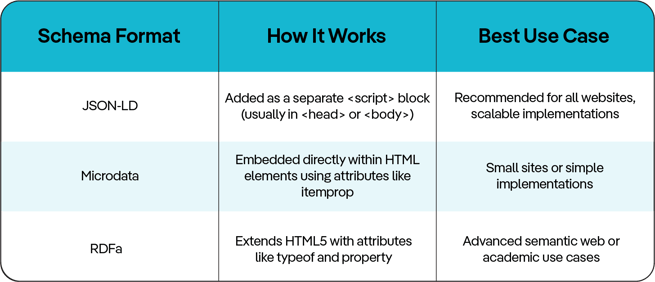
For AI search visibility in 2026, JSON-LD is the clear choice and is recommended officially by Google too (confirmed May 2025). As it sits separately from your HTML, it keeps things clean and uncluttered, making it easier for machines to read and process.
The best part? You can update it anytime without having to mess with your page design or layout.
How Schema Markup Directly Feeds AI Visibility
Now that you know how important schema markup is for visibility in search engines, let’s uncover how it actually works.
Here's what happens behind the scenes when an AI engine encounters a schema-marked page:
- Crawl - AI bots (GPTBot, CCBot, Googlebot) access your page.
- Parse - The JSON-LD block is extracted separately from the raw HTML code.
- Entity extraction - The AI identifies structured entities like your brand, your content type, and your expertise signals.
- Knowledge graph mapping - These entities are then mapped to AI’s existing knowledge graph nodes or new ones are created, as the case may be.
- Answer generation - When a user query matches your entity's domain, your content is surfaced as a citation source.
Entity Disambiguation: How Schema Defines Who You are
Schema helps AI engines to understand who you are and not just what you wrote. For instance, without Organization schema, "MarkeStac" is just text on a page to an AI. But with it, MarkeStac is a defined entity - a marketing automation agency with a known URL, service domain, and expertise signals that AI systems can confidently cite.
This is called entity disambiguation and it’s foundational to markup SEO. Because in AI search, your content isn’t just evaluated, it's attributed. If AI can’t clearly identify you, it’s far less likely to trust or cite you.
How Schema Influences What Google AI Overviews Include
After understanding who you are, AI systems decide whether your content should be surfaced in answers. While multiple factors come into play, schema strengthens several of the signals AI prioritizes:
- Clarity - Structured data makes it easier to interpret what your page is about
- Freshness - Recently updated, well-maintained content is more likely to be selected
- Authority - Content from credible, well-structured sources is preferred
- Directness - Pages that answer questions clearly and concisely perform best
In other words, schema doesn’t work in isolation but it amplifies everything else. It makes your content easier to process, easier to trust, and ultimately, easier to choose by AI.
Working with an SEO expert can help you to define entities, create relevant connections, and build trust and E-E-A-T signals to improve your overall AI visibility.
How Perplexity and Bing Copilot Use Structured Signals
Other AI platforms follow a similar pattern, with slight variations. Perplexity and Bing Copilot combine schema markup with Open Graph data to build their citation panels and responses.
They tend to favor content that is:
- Well-structured - Clear content types like FAQs, articles, and products.
- Entity-rich - Defined authors, organizations, and timestamps.
- Consistent - Structured data that aligns with on-page content.
What Do We Mean by AI Search Visibility Lift of up to 50%?
A 50% lift in AI search visibility doesn’t refer to a single metric like rankings but reflects how much more often your content is selected, cited, and surfaced inside AI-generated answers by using structured data. Practically, this could mean going from appearing in 10 out of 100 AI-driven queries to 15 out of 100.
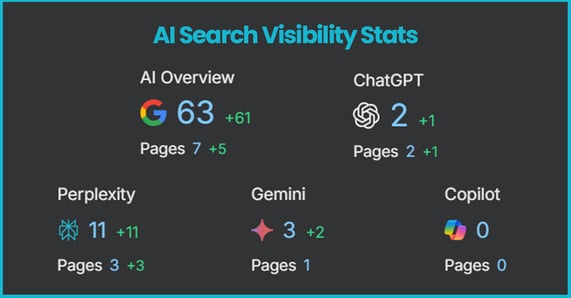
This is also supported by studies that show schema markup can increase AI citation likelihood by ~28%, while broader structured-content improvements drive 30-40% gains in visibility. In more optimized cases, pages are reported to be up to 73% more likely to be selected in AI-generated overviews.
Taken together, these findings point to an improvement approaching ~50% in AI search visibility - a realistic midpoint for well-implemented schema strategies. The actual results depend on the quality of your content, your domain authority, and how comprehensively you implement the structured data.
But the directional impact is consistently significant - using structured data by implementing schema markup makes it easier for AI to parse, classify, and cite your content, lifting your overall AI search visibility.
5 Schema Types That Actually Drive AI Visibility
There are five types of schema but not all contribute equally to AI visibility. In fact, a small subset drives the majority of citations and answer inclusion.
The table below is a compilation of the role and impact of each schema on AI visibility including where they appear and their implementation difficulty:
77.png?width=560&height=404&name=HubSpot%20CMS%20vs%20Traditional%20CMS%20Platforms%20for%20Intent-Based%20(4)77.png)
How to Implement Schema Markup for AI Search: A 4-Step Process
Let’s now uncover how you can implement schema markup SEO for AI search visibility. We have defined a four step process that our SEO experts use, this step-by-step process works for any platform with some specific instructions for HubSpot users:
Step 1: Audit Your Current Schema State
Before implementing anything it is important to understand the state of your current schema. Start with Google's Rich Results Test to check your individual pages. Then use Google Search Console → Enhancements for a site-wide view to see which schema types are detected and which ones have errors.
Next, categorize your pages into three groups:
- Zero schema - contains no structured data at all
- Partial schema - some markup is present but it’s missing the required properties
- Incorrect schema - schema type doesn't match your page content, or the properties are inaccurate
In HubSpot, you can use the SEO Recommendations tool to surface pages flagged for technical issues and combine this with the Rich Results Test for schema-specific diagnosis.
Step 2: Prioritize Your High-Impact Pages
Not every page needs schema but some deliver significantly higher AI visibility. It is therefore crucial that you focus on the pages that are most likely to be used in AI-generated answers.
These include:
- FAQ sections & Q&A blogs - Highest citation potential
- Pillar / cornerstone content - Article + Author schema for E-E-A-T signals
- Product or service pages - Critical for commercial and transactional queries
- HowTo guides - Ideal for step-by-step AI responses
While Google has reduced the visibility of FAQ and HowTo rich results in traditional search, this structured format is still widely used by AI systems, making it high ROI for AI visibility.
Step 3: Implement Schema
There are two common ways through which you can implement schema markup to your page. These include:
Option A - Google Tag Manager (platform-agnostic)
Add your JSON-LD as a Custom HTML tag, fired on specific page URLs. This is the fastest route for non-developers across any CMS.
Option B - Direct page implementation
Add the JSON-LD block inside your page's <head> section for more control.
For HubSpot users, go to Marketing → Website → Website Pages, open the page editor, click Settings → Advanced, and paste your JSON-LD into the Header HTML field.
For site-wide schema (like Organization), add it to your theme's <head> via the Design Manager.
Important Note: Your schema must accurately reflect what’s visible on the page as mismatched or misleading markup can be ignored or devalued by search engines.
Step 4: Validate and Monitor (Track Over 60–90 Days)
Just adding the schema markup to your HTML code isn’t enough for AI visibility, it is equally important to ensure that this schema works correctly.
Here’s what you check after implementing your schema markup:
- Use Google's Rich Results Test and Schema Markup Validator to validate your schema.
- Check the Rich Results report in Google Search Console to confirm its detection.
- Track visibility trends and emerging AI citation rate using tools like Semrush's AI Visibility report, Profound, or AirOps over a 60-90 day window.
What Happens When You Implement Schema Correctly
Let’s see how a page marked with schema fares against one that doesn’t have schema added to it:
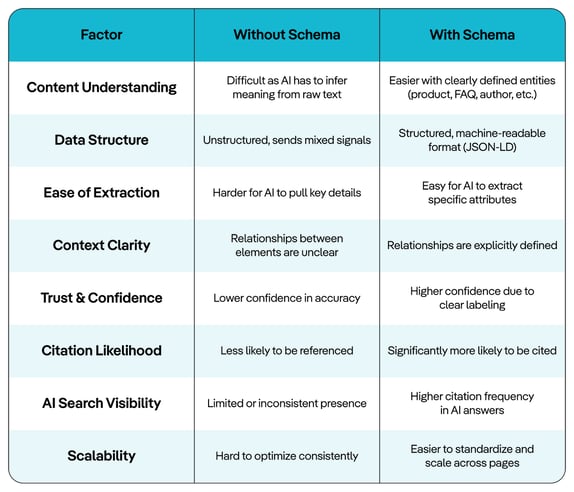
Businesses implementing structured schema strategically have reported meaningful improvements in AI-driven visibility and answer inclusion. Also, the brands seeing the biggest gains aren't just adding schema, they're combining it with fresh content, clear entity signals, and consistent off-site validation.
Why Most Schema Implementations Fail
Knowing that schema matters for visibility in AI search isn't enough, many implementations underperform because they're not done properly.
Here’s where most implementations fall short:
1. Using Plugins Without Strategy
Schema plugins make implementation easy but they often apply the same markup across every page, whether it fits or not.
For example, marking a contact page as an Article doesn’t help, it creates irrelevant and diluted signals. Over time, this makes it harder for AI systems to confidently interpret your content.
2. No Entity Mapping
Schema works best when it connects the dots. If your Organization schema isn’t linked to your service pages, blog posts, and author profiles through consistent identifiers, AI systems will struggle to build a coherent understanding of your brand.
The result? You remain as just another mention, not a clearly defined entity.
3. Disconnected Schema Types
It’s not just about adding schema, it’s about making sure it all aligns. You might have a FAQ schema on a blog post, but if your Article schema references a different author than your Organization schema, you’re sending mixed signals.
This inconsistency weakens trust and in AI search, trust directly impacts whether you get cited.
4. Static Implementation
Schema markup isn’t a one-time task. AI systems favor fresh, accurate, and up-to-date information. So, if your schema points to outdated prices, removed products, or old publication dates, it can hurt your credibility over time.
Remember, even strong content can lose visibility if the underlying signals aren’t maintained. That’s why you need an SEO expert on your side, so you get the schema markup right the first time.
Why Your Website Isn’t Showing Up in AI Search
If you relate to 2 or more of these, you have an AI visibility gap:
- Your content explains topics well but doesn't define entities clearly
- Your services are described in paragraphs but not structured for machines
- You have no FAQPage or structured Q&A format on key landing pages
- Your schema was set up by a plugin and never reviewed
- Your pages haven't been updated in more than 60 days
- You have no Author or Organization schema connecting your content
Each of these is a signal AI engines can't process which means they cite someone else instead of you.

Final Thoughts
Google AI Overviews are now a part of over 55% of all Google searches. ChatGPT processes 2.5 billion queries a day. AI-referred traffic converts around 3x to 5x the rate of traditional organic search. And sites using structured data strategically are being cited 44% more often by AI platforms than those without.
All these statistics point to one thing - Schema Markup is no longer optional for AI search visibility, it is the difference between being cited and being invisible. Here's a simple 3 step action checklist that ensures you are cited by AI: Audit your current schema → Prioritize FAQPage + Article → Implement and monitor in 90 days.
If you are still not sure why you don’t show up AI results, book a free schema audit with MarkeStac. Our Marketers will identify exactly which of your pages are invisible to AI engines and tell you what to fix and in which order.
Frequently Asked Questions
Got questions? We’ve got answers. Explore the most common queries about Markestac's automation platform and learn how it can streamline your processes, connect your tools, and drive growth.
Does Schema Markup still matter if I already rank on page 1?


Yes, Schema Markup still matters even if you rank on page 1 as ranking and being cited by AI are two separate outcomes. Schema markup helps AI engines to understand the context of your page, improving your chances to get mentioned or cited by AI.
How long does it take for schema to impact AI search visibility?
Schema shows results faster than traditional SEO with some teams reporting early AI citation improvements within 30-45 days of implementation. But for reliable trend data, it is important that you monitor it over a 60-90 day window.
Is Schema Markup the same as structured data?
Although Schema Markup and structured data are not the same, they are deeply connected. Schema markup is a type of "Structured data" which is a broader category, Schema markup uses the schema.org vocabulary and is the most widely adopted standard for web content.
What's the difference between Schema for Google vs. AI engines like Perplexity?
Google uses schema to power Rich Results and AI Overviews while Perplexity and Bing Copilot use both schema and Open Graph metadata to build their citation panels. A well-implemented schema in the JSON-LD format will serve you well for most AI platforms too.
Can wrong schema implementation hurt my SEO?
Yes, wrong schema implementation including mismatched schema types, inaccurate properties, or schema that contradicts on-page content can lead to manual actions in Google Search Console and suppress your Rich Results eligibility. It is therefore important to always validate before deploying.
Does having schema guarantee I'll appear in AI Overviews?
Although implementing schema significantly improves your chances of appearing in AI overviews, AI inclusion also depends on other factors too. These include content quality, domain authority, freshness, and topical relevance.
Do I need a developer to implement Schema Markup?
No, you don't necessarily need a developer for implementing schema markup as JSON-LD via Google Tag Manager requires no development work. For HubSpot users, schema can be added directly in page settings without touching code. You can also consult a HubSpot partner to accelerate a complex, site-wide entity implementation.

.jpg)





.png?width=80&height=81&name=mail-01%20(1).png)


.svg)





.png?width=410&height=126&name=Group%201000005667%20(1).png)