
.png?width=14&height=14&name=Icon%20(1).png)


.png?width=24&name=Group%20(3).png)



%201.svg)



.svg)



.svg)
























How Can We Help Your Business?
Select a service below and our experts will
reach out to you within 24 Hrs.
 No commitment
 30 minutes
 100% free
Introduction
If your current growth strategy relies heavily on chasing leads, closing deals, and starting all over again, then you’re not alone. For years, businesses have followed the traditional marketing funnel: attract, convert, and repeat. But today the customers don’t behave in straight lines, and sustainable business growth doesn’t come from one-time wins.
This is where flywheel marketing comes in. Instead of treating your customers as the endpoint, the HubSpot flywheel places them at the centre of growth, turning engagement, loyalty, and advocacy into momentum to fuel it.
Want to learn the best practices of flywheel marketing to drive customer-led growth? This guide by MarkeStac is here to help! In this blog, we will uncover everything from what flywheel marketing is, to its benefits, and how you can build a flywheel marketing strategy for your business.
What Is Flywheel Marketing?
Flywheel marketing is a customer-centric marketing approach that presents the customer’s journey as a flywheel where customer satisfaction drives the momentum. This momentum results in repeat purchases, product promotions and referrals.
This marketing model has been highly successful and has been implemented by big names like Amazon, HubSpot, and Spotify, etc. It is also a cost-effective, long-term revenue booster that’s based on three core principles: Attract, Engage, and Delight. Learn more about the HubSpot Flywheel and its three stages through our guide on the same.
Funnel vs. Flywheel: What’s the Real Difference?
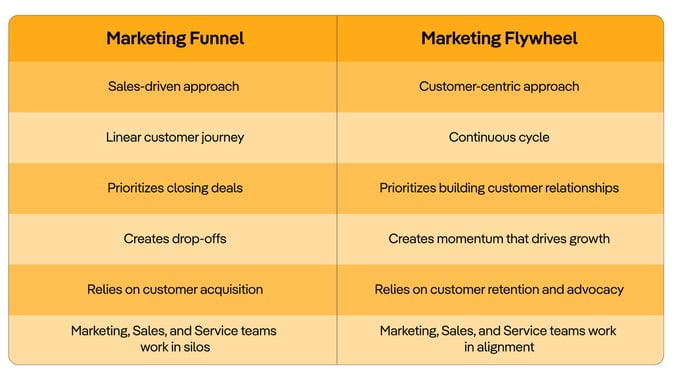
The marketing flywheel was launched at the HubSpot INBOUND conference, where it replaced the earlier marketing funnel, which has been around for ages. The two marketing models differ significantly as the marketing funnel is focused on a linear customer journey that ends with closing the deal while the flywheel is centred around creating momentum through happy customers to drive repeat buys and brand advocacy.
Here’s a tabular representation of marketing flywheel vs. funnel:
How Flywheel Marketing Creates Predictable Growth
In flywheel marketing, the customer is at the center of all marketing and sales efforts. These efforts however aren’t just centered around the customer making the first purchase but on nurturing long-term relationships that turn these customers into loyal advocates of your brand.
With positive, consistent customer experiences at every touchpoint, the flywheel begins to gain momentum. Satisfied customers return time and again, engage more deeply, and recommend your brand to others, this creates a self-sustaining cycle where trust, retention, and referrals continuously fuel growth.
Over time, this momentum reduces reliance on constant lead generation, making your business growth more stable, scalable, and predictable. As HubSpot specialists, MarkeStac helps you with just that; we deliver a customized marketing strategy so you evolve from one-time conversions to consistent, long-term growth.
Benefits of Flywheel Marketing for Businesses
As we discussed earlier, with flywheel marketing you can create a self-sustaining growth system where your happy customers fuel your growth. Here’s how flywheel marketing can benefit your business:
- Boosts your customer retention.
- Lowers the customer acquisition costs.
- Builds stronger brand trust and loyalty.
- Enhances customer experience with reduced friction at each touchpoint.
- Improves the alignment between your teams for better efficiency.
- Brings a greater lifetime customer value.
- Brings more organic referrals and word-of-mouth growth.
How to Build a Flywheel Marketing Strategy
Adopting a flywheel marketing strategy is definitely a win-win for both the customers and your business. The customers get a seamless personalized experience while the company gains the customers as their brand advocates bringing in warm leads.
Wondering how you can build this scalable strategy for your business? Here’s a step-by-step guide by the HubSpot experts at MarkeStac, it is sure to bring predictable, long-term growth for your business:
-
Recognize your customers & map out their buyer journey
Any good marketing strategy begins with a clear understanding of the customers. Map out your customer’s buyer journey, this will help you understand the needs, expectations, and pain points at every touchpoint from their first interaction to long-term engagement.
These insights will also strengthen each of the three stages of the Flywheel. It will help you attract the right audience with relevant content, engage them through personalized and timely interactions, and delight them by anticipating their needs and delivering value even after they make their purchase.
-
Set up metrics and goals for each stage of the flywheel
If you don't have a clear understanding of what to track, how will you measure if your efforts are successful? Defining clear goals and metrics for each stage of the flywheel is thus important to ensure that each stage contributes to predictable growth of your business.
Here’s what you should track for each stage of the marketing flywheel.
-
- Attract: website engagement and lead quality.
- Engage: conversion rates and deal velocity.
- Delight: retention, NPS, and repeat purchases.
-
Identify and address friction points
Next comes the part where you identify the friction points that can break your marketing flywheel’s momentum. A few factors that contribute to this include, slow response times, inconsistent communication, unclear handoffs, or lack of post-sale support.
You can overcome this by removing internal silos and creating smoother transitions between marketing, sales, and service teams. This ensures your customers experience continuity, trust, and value at every stage of the flywheel, building stronger and better relationships.
-
Use analytics and data-driven insights to adapt and evolve
Your flywheel strategy shouldn’t be static, it should evolve as the customer behaviour and expectations change. The HubSpot CRM plays an important role here, analytics and performance data helps you to continuously refine messaging, improve experiences, and optimize processes.
Tracking engagement patterns, conversion trends, and customer feedback also helps your teams make informed decisions that reduce friction, improve personalization, and keep the flywheel spinning efficiently over time.
Common Mistakes to Avoid in Flywheel Marketing
Although flywheel marketing may look simple at the first glance, it is actually a strategic long-term investment that requires consistency, alignment, and a strong focus on customer experience.
Many businesses thus struggle not because the model doesn’t work, but because they have implemented it without the right mindset or structure.
From treating the flywheel like a traditional funnel to overlooking post-sale engagement, here’s a few common mistakes that can slow down the momentum and prevent your business from seeing the full impact of flywheel marketing:
- Treating the flywheel as a rebranding of funnel instead of viewing it as a separate marketing model.
- Focusing only on acquisition of clients and ignoring the post-sale engagement.
- Failing to align the marketing, sales, and service teams.
- Overlooking the friction points in the customer journey.
- Collecting the customer feedback but not acting on it.
- Over-automating without personalization or context.
- Measuring success only by conversions instead of customer retention and advocacy.
- Expecting instant results instead of building long-term momentum.
If you are facing any of these issues with your marketing funnel, then MarkeStac can help you with the combined expertise of digital marketing and the smart HubSpot CRM.
Is Flywheel Marketing Right for Your Business?
If, even after all this discussion about the flywheel marketing strategy and its benefits you are still wondering “Is flywheel marketing right for my business?”, then here’s a few pointers to help you out.
Flywheel marketing is the right fit for your business, if:
- You value long-term relationships with your customers, over one-time conversions.
- Customer retention, loyalty, and repeat business impacts your company’s revenue.
- Referrals and word-of-mouth play a major role in how you acquire new customers.
- Your sales cycle involves multiple touchpoints or ongoing engagement.
- You want predictable and scalable growth instead of short-lived campaign-based spikes.
- Your marketing, sales, and service teams are ready to work in alignment with each other.
- Customer experience is a key differentiator for your brand.
- You are willing to continuously optimize based on data-driven insights and customer feedback.
Conclusion
The flywheel marketing represents a vital shift in how businesses think about their growth. By placing the customer at the centre and focusing on building long-term relationships, the flywheel creates an undeniable momentum that compounds over time, delivering predictable and sustainable growth.
When implemented thoughtfully using the right tools and data, this marketing flywheel turns every customer interaction into an opportunity to build trust and drive growth. With HubSpot’s CRM and MarkeStac’s expertise guiding your marketing strategy, your business moves beyond short-term wins to a growth engine that keeps spinning.

Frequently Asked Questions
Got questions? We’ve got answers. Explore the most common queries about Markestac's automation platform and learn how it can streamline your processes, connect your tools, and drive growth.
What is the concept of flywheel?


The concept of flywheel is built around how a business generates sustainable momentum through continued efforts. These customer centred efforts result in scalable and predictable business growth.
How is flywheel marketing different from funnel marketing?
Flywheel marketing is completely different from funnel marketing. In flywheel marketing, your marketing, sales, and service teams work in alignment to promote repeat buys and customer referrals by building strong customer relationships while the funnel marketing represents a linear sales-driven approach which ends as soon as the customer buys from you.
What are the key stages of the flywheel marketing model?
- Attract: Introduce your brand to the customers and highlight how you can address their pain points.
- Engage: Use engaging and personalized content to nurture leads and move them ahead in their buyer journey.
- Delight: Use exceptional customer service and post-sales support to turn customers into brand advocates.
Is flywheel marketing suitable for small businesses?
Yes, flywheel marketing is suitable for small businesses as it presents a low-cost growth strategy that’s built around happy customers driving the momentum for sustainable growth.
How long does flywheel marketing take to show results?
It takes around six months for your flywheel marketing efforts to show significant results. You will however start to notice an increase in traffic of your paid ads around the three-month mark.
How can I get started with flywheel marketing?
You can get started with flywheel marketing with a better understanding about your customer and their buyer journey. It will help you attract them with relevant and valuable content, engage them with personalized experiences that’s tailored to their needs, and finally delight them with excellent customer service. All these help you build a loyal customer base that drives your growth through repeat buys and brand referrals.





.png?width=80&height=81&name=mail-01%20(1).png)


.svg)





.png?width=410&height=126&name=Group%201000005667%20(1).png)