
.png?width=14&height=14&name=Icon%20(1).png)


.png?width=24&name=Group%20(3).png)



%201.svg)



.svg)



.svg)


























How Can We Help Your Business?
Select a service below and our experts will
reach out to you within 24 Hrs.
 No commitment
 30 minutes
 100% free

Introduction
The fact that retaining existing clients is far more cost-effective than constantly acquiring new ones has shifted how marketers work. Marketing is no longer focused on closing new deals, it has become more about creating meaningful, long-term relationships with your existing customers.
And this is exactly where the HubSpot Flywheel comes in. Instead of the traditional linear customer journey in the funnel, the HubSpot Flywheel model places the customer at the center. It aligns your marketing, sales, and service teams to drive sustainable and momentum-led growth.
Not sure where to start? Don’t worry! This MarkeStac guide will dive into the details of this marketing model, address its three core stages, and how you can successfully implement the HubSpot Flywheel model for measurable growth.
What is the HubSpot Flywheel?
Before we go into the details of the implementation of this marketing flywheel, let’s first understand what a flywheel in HubSpot is. The HubSpot Flywheel is a marketing model that represents the buyer’s journey through a perpetual circular system.
While the previous marketing funnel presented a linear customer journey that ended with the customer making a purchase, the HubSpot flywheel extends this further.
According to this model, it is your happy customers that generate the momentum to drive your referrals and repeat sales, which is why it keeps the customer at the center to drive your revenue and growth.
This customer-centric model was launched at the annual INBOUND conference of HubSpot. Catch the highlights of the INBOUND 2025 here.
The Three Core Stages of the Flywheel
The HubSpot Flywheel model is based on three core pillars. These pillars keep the customer engaged and their positive experience throughout the cycle generates the momentum to keep the wheel spinning and your business going.
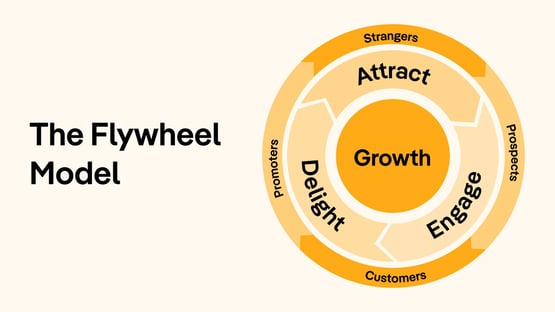
Here’s a brief overview of the three core stages of the flywheel:
Attract
This first stage involves drawing in your potential customers through relevant, high-value content. It allows them to learn all about your company and how you can address their needs. The forces you can apply here to keep the customers engaged and generate the momentum to move them include:
- Content marketing
- Search Engine Optimization (SEO)
- Targeted paid ads
- Social media marketing
You can check out our last blog to learn more about how connecting HubSpot and Social media together is the best decision to gain measurable growth from your social engagement.
Engage
This second stage is focused on engaging your potential customers and building relationships through tailored solutions. Segmenting your potential customers is essential here to deliver personalized and relevant experiences that build trust. This converts your potential leads into customers.
Here’s a few drivers to generate momentum in this stage:
- Email marketing and automation
- Landing pages and forms
- AI-supported live chat and messaging
Delight
The final stage in the flywheel model is for your existing customers. By delivering excellent ongoing support, personalized communication, and seamless service experiences, you can turn your satisfied customers into your loyal advocates. This makes marketing a continuous cycle.
Here’s what keeps the momentum going at this stage:
- Customer Feedback
- Loyalty programs
- Proactive customer service
The three stages of this marketing flywheel, attract, engage, and delight, thus work in sync to drive continuous, customer-led growth.
Why Does the Flywheel Work Better than Traditional Funnels?
The shift towards flywheel model is quite clear with modern businesses prioritizing customer experience, retention, and long-term value. However, the differences between the traditional funnel and the Flywheel become even more evident when you compare how each approach drives business growth.
Here’s a few pointers that shed light on why the flywheel works better than the traditional funnel approach:
- Keeping up with the changes in customer buying behaviour, the flywheel utilizes a customer-first approach that keeps customers at the centre, while the traditional funnels focus mainly on closing leads.
- The funnels ended right after a sale but with the flywheel approach growth doesn’t just stop at conversion. It continues by nurturing customer loyalty, retention, and advocacy.
- With the flywheel model, the retained and referred customers reduce dependence on constant new lead generation, significantly reducing the customer acquisition costs.
- The flywheel model enables a stronger collaboration between the marketing, sales, and service teams instead of operating in silos, like in the funnel approach.
- Each positive customer interaction adds energy to the flywheel which keeps it spinning and accelerating long-term growth.
.jpg?width=588&height=331&name=OLD-Sales-Funnel%20(2).jpg)
How to Implement the HubSpot Flywheel?
Now that you understand what is a Flywheel in HubSpot, what powers it, and why it outshines the traditional funnel, the next step is putting it into action. A key factor that slows this flywheel approach is friction (anything that creates a poor, disconnected, or delayed customer experience).
You can remove this friction and build momentum by using the HubSpot tools right. Building shared pipelines, automation workflows, customer feedback, and service insights is where it all happens.
Here’s how you can implement the HubSpot Flywheel model for each stage of the process:
Attract- Create engaging content to attract your customers. Use HubSpot's blog, landing pages, videos, and guides to solve customer problems.
- Optimize this content for SEO and use targeted ads to bring in the relevant traffic.
- Use HubSpot forms and pop ups to turn your potential visitors into contacts.
- Use marketing automation, email marketing, and lead scoring to send tailored content to your potential customers.
- Align your marketing, sales, and service pipelines to ensure smooth handoffs and reduce internal friction between teams.
- Use ticketing, chat, knowledge bases, and proactive support in HubSpot to provide ongoing value to customers.
- Use NPS (Net Promoter Score), CSAT (Customer Satisfaction) and feedback surveys to identify needs and offer support.
- Create loyalty programs, exclusive offers, and use the data-driven insights to drive the momentum.
Want to gain more clarity and implement the flywheel to fuel your business growth? Reach out to MarkeStac to build a tailored marketing strategy.
Measuring Success with the Flywheel
The HubSpot Flywheel isn’t just a conceptual model, it is a practical solution to the shift in customer buying behaviour. It is designed to drive real, measurable growth by placing customer needs above all.
However, just implementing this model isn’t enough, measuring its success is equally important to track how well your Flywheel spins and how to reduce the friction to strengthen your customer relationships over time.
Here’s a few key metrics that you should track:
- Customer Retention Rate
Higher retention rate indicates that your “Delight” stage is working effectively, keeping your customers engaged and loyal.
- NPS & CSAT surveys
These surveys reveal how satisfied your customers are with your product or services and whether they are likely to recommend your brand.
- Customer Lifetime Value (CLV)
A growing CLV shows that your customers are repeatedly buying or engaging with your services, this proves your Flywheel’s effectiveness.
- Conversion Rates at Each Stage
Track how your prospects move through each stage: Attract, Engage, and Delight. Higher conversions indicate reduced friction and smooth transitions across stages.
- Time-to-Value (TTV)
This tracks how fast your customers realize significant value, reducing friction and accelerating the delight cycle. - Customer Referrals
Monitor referrals, social shares, and testimonials. These delighted customers who advocate for your brand accelerate your Flywheel’s momentum.
By tracking these metrics consistently, you can identify the friction points, optimize your marketing processes, and ensure that your Flywheel continues to generate sustainable, customer-driven growth.
Conclusion
The HubSpot Flywheel represents a fundamental shift in how modern businesses should approach marketing. By moving beyond the linear funnels and placing the customer at the centre, the HubSpot Flywheel creates an undeniable momentum that drives customer loyalty, retention, and further referrals.
As a HubSpot Partner, MarkeStac helps businesses move beyond the funnel approach and implement the Flywheel with clarity and confidence. We guide you through everything from CRM onboarding, and automation to service optimization and performance tracking, to ensure your Flywheel keeps spinning perpetually, generating revenue.
Frequently Asked Questions
Got questions? We’ve got answers. Explore the most common queries about Markestac's automation platform and learn how it can streamline your processes, connect your tools, and drive growth.
What is HubSpot's flywheel best described as?


HubSpot Flywheel can be best described as a customer-centric growth model. This circular model keeps the customer at the center of everything, driving referrals, repeat purchases, and business growth through the momentum of happy customers.
What is the difference between flywheel and funnel marketing?
The funnel marketing is a linear approach that ends with a customer making the purchase while the flywheel model aims at using happy customers to drive referrals, repeat buy, and brand advocacy.
What is the flywheel approach?
The flywheel approach is a business strategy that focuses on delighting customers to generate the momentum to keep the business growing. This is possible through satisfied customers who make repeat purchases, and refer your brand to their friend.
What are the three main purposes of a flywheel?
The three main purposes of a flywheel in HubSpot is to attract potential customers, engage them with relevant service and delight them into becoming brand advocates.
Why should my business use the Flywheel approach?
Your business should use the Flywheel approach to delight your existing customer base into making repeat purchases and referring your brand to a friend. Through this your business becomes a customer-led growth engine.
Can small businesses benefit from the Flywheel model?
Yes, small businesses can benefit from the Flywheel model as it is much easier and cost-effective to retain a customer than onboarding a new customer, and the flywheel model helps with just that.
What tools can help implement the Flywheel?
While the flywheel is supported by various softwares to reduce friction and keep it spinning, the Customer Relationship Management (CRM) software is at the center of it. Other tools like marketing automation, SEO, email marketing, social media marketing, and Live chatbots, etc, help out too.





.png?width=80&height=81&name=mail-01%20(1).png)


.svg)





.png?width=410&height=126&name=Group%201000005667%20(1).png)