
.png?width=14&height=14&name=Icon%20(1).png)


.png?width=24&name=Group%20(3).png)


%201.svg)


.svg)

.svg)






















How Can We Help Your Business?
Select a service below and our experts will
reach out to you within 24 Hrs.
 No commitment
 30 minutes
 100% free
Introduction
As businesses continue to explore AI, what most of them don’t realise is that they don't necessarily need more AI tools for better ROI. They just need a better way to connect the tools they already have to their CRM, data, workflows, and teams.
This is exactly what AI enablement is about, it builds the connection between your existing tools. Instead of using AI as a collection of isolated applications, AI for businesses integrates it into the processes that drive their marketing, sales, customer support, and operations.
This MarkeStac guide explains how you can approach AI for business automation, CRM, marketing, sales, and forecasting as part of a connected AI enablement strategy.
What Is AI Enablement?
AI enablement is the process of integrating artificial intelligence tools, workflows, and practices into a business's core functions including marketing, sales, CRM, customer support, data, and operations. It supports your teams to work faster, make better decisions, and scale output without increasing your headcount.
Unlike buying a single AI tool, AI enablement is a strategic programme that connects every AI investment you’ve made into one coherent system. It is also worth separating AI enablement from AI adoption and traditional enablement.
AI adoption is simply buying and using AI tools. It’s a starting point for your business and not a complete strategy. A team can adopt ten AI tools and still see no meaningful improvement if these tools do not talk to each other or feed into a shared data layer.
Traditional enablement, typically refers to giving your sales or marketing teams the right content, training, and processes to do their jobs. AI enablement extends this concept by automating the distribution, personalization, and iteration of these resources, and then applying the same logic across every other business function.
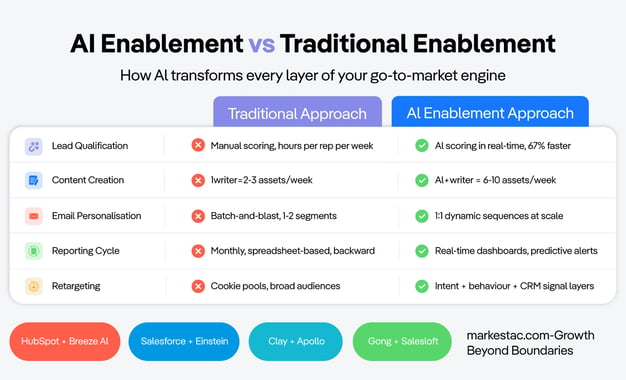
AI Enablement vs Traditional Enablement
Where traditional enablement is manual and periodic, you create a sales playbook, train the team, and update it quarterly; AI-driven enablement is continuous. AI monitors every sales call, identifies what messaging works, updates the recommended talk tracks, and surfaces the right content to the right rep at the right deal stage, automatically.
Both processes work to better equip your teams, the difference is in their velocity and scale. The table below highlights some major differences between traditional enablement and AI-driven enablement.
Why Businesses Are Prioritizing AI Enablement Now
AI has been around for decades but three things converged in 2024 and 2025 that made AI enablement urgent rather than optional.
- AI tools became affordable and accessible - HubSpot's Breeze AI, Salesforce Einstein, and dozens of point solutions no longer require a dedicated data science team to operate.
- Buyer expectations shifted - Prospects now receive AI-personalized outreach from competitors every day. Generic campaigns and delayed follow-ups are now a competitive disadvantage and not just a missed opportunity.
- The cost of doing nothing became visible - Businesses that ran AI pilots in 2023 and 2024 are reporting measurable advantages in pipeline velocity, content output, and customer retention. The gap between these businesses and those still debating strategy is widening every quarter.
How to Build an AI Enablement Strategy for Your Business
Now that you know why AI enablement is important for your business, let’s discuss how you can build an AI enablement strategy for your business.
Step 1: Audit Your Current Stack
List every tool that your business uses across marketing, sales, CRM, support, and operations. Identify which of these already have AI capabilities you are not using, which have API connections that allow automation, and where the biggest manual bottlenecks are.
Key Insight: Most businesses discover that 60-70% of the AI capability that they need is already available inside the tools they are paying for but not fully using..
Step 2: Identify High-Impact Automation Points
From your audit, rank the manual processes by time consumed multiplied by frequency. The processes at the top of that list are your first automation targets. Focus on three to five processes that, if automated, would free up the most combined team hours per week.
Step 3: Choose the Right AI Tools for Each Function
Match tools to your existing stack wherever possible. A HubSpot shop should activate Breeze AI before evaluating third-party alternatives. A Salesforce shop should evaluate Einstein. Only add a new platform when a specific capability gap cannot be addressed by what you already have.
Step 4: Train Your Team (Governed AI Adoption)
AI adoption fails when teams do not understand what the AI is doing, why it is making certain suggestions, or how to override it when it is wrong. Training should cover how each AI tool works at a conceptual level, what the quality guardrails are, when human judgment should override AI output, and how to give the AI better inputs to improve its outputs over time.
Step 5: Measure and Iterate
Define success metrics for each AI implementation before you launch it. Review monthly for the first quarter and adjust based on what the data shows.
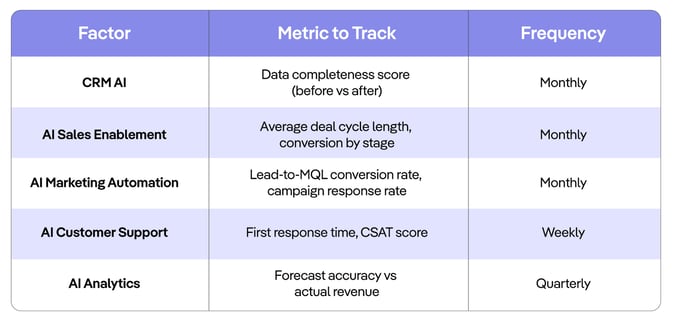
This continuous optimization of your AI implementation is important to ensure that the system reflects your current processes and scales as you grow.
AI Enablement Use Cases across the Business
AI enablement can support almost every stage of the customer and revenue lifecycle but its value does not come from simply adding AI to each department independently. You need to connect your data, automation, AI, and human decision-making across functions.
For example, an AI-enriched contact record can improve your lead scoring. This score can influence sales prioritization, while sales activity feeds back into the CRM and improves forecasting. The same customer data can then inform marketing segmentation, retargeting, and customer support.
The following use cases show where you can apply AI for businesses and how these capabilities can work together:
1. AI for Business Automation: Workflows that Scale
AI for business automation means using AI to reduce repetitive manual work while making workflows more responsive to the information available at each stage. Where traditional automation follows predefined rules: if X happens, do Y; AI can make these workflows more dynamic by analyzing information, personalizing outputs, and supporting decisions based on patterns or historical data.
For businesses, this can mean automating more than simple notifications and task assignments. AI can support processes such as lead routing, CRM updates, reporting, customer communication, and operational workflows.
AI Business Automation Tools Worth Using in 2026
When you’re evaluating AI for business automation tools, prioritize their integration with your existing CRM and business systems over the number of features a platform offers.
The table below includes a list of different AI automation tools you can explore for your business.
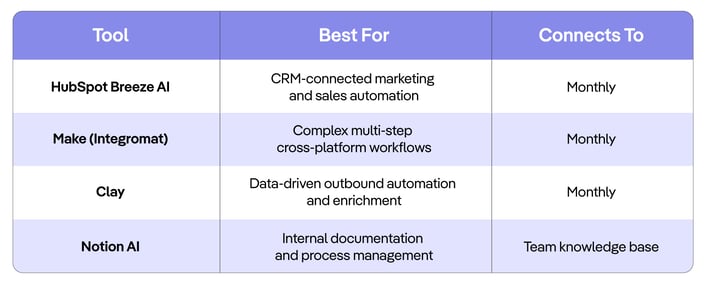
The right automation tools depend on the systems you already use and the process you are trying to improve.
2. AI Data Enrichment: Feed Your System Clean Data
AI data enrichment is the automated process of filling gaps in your CRM or database by pulling in verified contact information from multiple sources, cross-referencing available data, and pushing relevant information into the CRM.
Depending on the use case, AI enrichment can add details such as job title, company size, industry, revenue, technology used, funding information, decision-maker details, and buying signals.
AI can also help automate this process so, when a new contact enters your CRM, enrichment can be triggered automatically, giving marketing and sales teams more context before they engage with the prospect.
For go-to-market teams, this creates a stronger foundation for segmentation and prioritization. Instead of treating every lead equally, teams can combine firmographic, behavioural and intent data to identify which contacts and accounts deserve attention.
3. AI for CRM Efficiency: The Central Nervous System
Your CRM is the hub where every AI signal in your business should converge. AI for CRM means using artificial intelligence to keep your customer relationship management platform accurate, active, and predictive, automatically.
AI can support tasks such as activity logging, call summarization, data enrichment, lead scoring, deal insights, next-action recommendations, and forecasting. It turns your CRM from a database people update manually into a system that updates itself and tells your team what to do next.
Data quality is particularly important. Contacts change roles, records become outdated and sales activity can go unlogged. AI can help capture information from conversations, identify missing or outdated data and reduce the amount of manual CRM administration required from sales teams.
Salesforce AI vs HubSpot AI: A Practical Comparison
Two of the most commonly used CRMs HubSpot and Salesforce offer AI capabilities to keep your CRM at the center of the customer journey. The table below includes a practical comparison of the two.
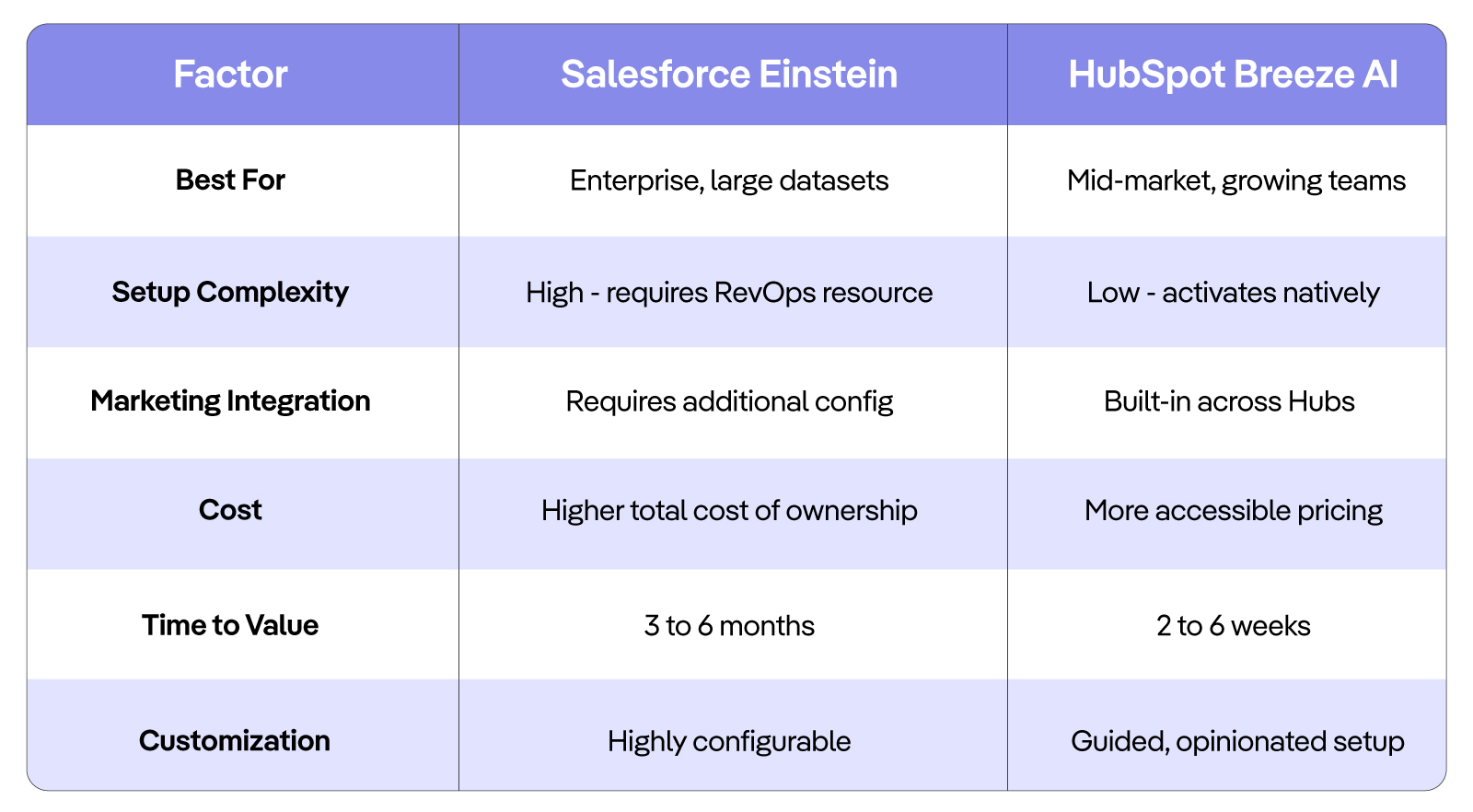
The right choice depends on your existing platform, team size, and how much configuration resources you have available.
4. AI for Go-to-Market Strategy
AI for go-to-market strategy means using artificial intelligence to define your ideal customer profile (ICP) with greater precision, segment markets at scale, identify in-market accounts before your competitors do, and model revenue scenarios before you commit a budget to a channel.
AI helps your GTM strategy for:
-
ICP development - By analyzing patterns across existing customers, including industry, company size, roles, technology, sales cycles and customer value to inform segmentation and account selection.
-
Account-based marketing (ABM) - By identifying ICP-fit accounts, monitoring engagement, and helping marketing and sales teams coordinate personalised outreach.
-
Revenue scenario modelling - By combining factors such as pipeline volume, conversion rates, deal values, sales cycles and channel performance, businesses can explore different revenue scenarios and understand which variables have the greatest effect on outcomes.
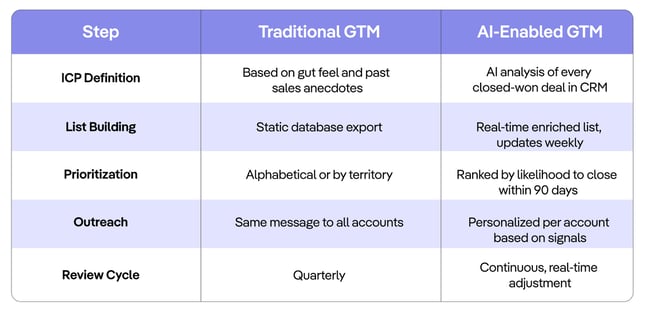
Traditional GTM vs AI-Enabled GTM
5. AI in Marketing: Campaigns, Content, and Channels
AI in marketing means using artificial intelligence to support every layer of marketing execution, from content production and SEO to email personalization and paid media.
It does not replace your marketers but removes the manual, repetitive layers of marketing execution so that they can spend their time on strategy, creative direction, and relationship building.
AI in marketing supports activities like:
- content research, ideation, drafting, repurposing, search-intent analysis, content clustering, and optimization.
- producing and adapting content more efficiently; human expertise still remains important for accuracy, positioning and brand quality.
- email marketing by using information such as lifecycle stage, engagement, industry, role, website activity, and deal stage to support more relevant personalization and timing.
- paid media optimization by analyzing audiences, campaign performance, and creative variations, using behavioural and CRM signals to refine targeting and campaign decisions.
A connected AI marketing workflow might look like this:
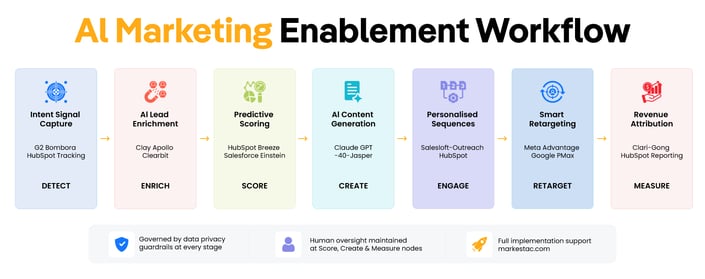
This is where AI enablement moves beyond individual marketing tools and becomes an integrated operating process. When these signals flow into the CRM, AI in sales can use them to prioritize follow-ups and identify accounts showing stronger buying intent.
6. AI for Sales Enablement: From Prospecting to Close
AI in sales enablement uses artificial intelligence to give sales teams the right information, content, and guidance at every stage of the sales process, automatically. It covers AI-powered lead scoring, intelligent prospecting, call intelligence, content recommendations, deal risk flagging, and CRM automation.
The goal of using AI in sales is to reduce the time your sales reps spend on admin and research so they spend more time on conversations that convert.
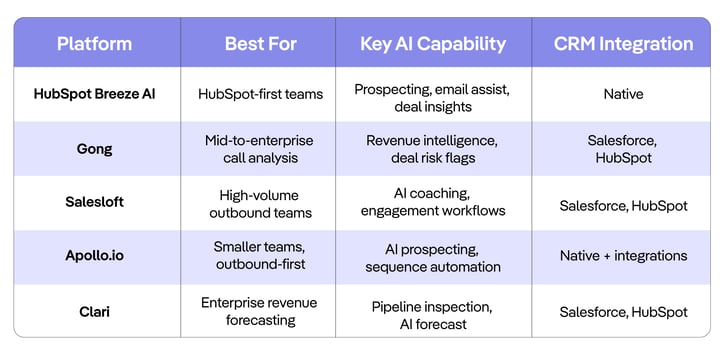
Best AI Sales Enablement Platforms: Which One Fits Your Team?
7. AI for Customer Support: Close the Loop After the Sale
AI enablement should continue after a prospect becomes your customer. AI for customer support means using artificial intelligence to help classify and route support tickets, answer common questions, suggest responses, identify sentiment, and escalate conversations that require human judgement.
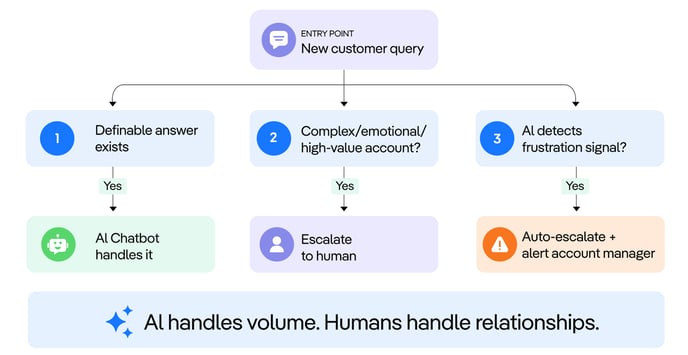
The practical distinction is simple: AI can handle volume, while people handle judgement and relationships.
When connected to customer and CRM data, AI can also help your support teams to respond with more relevant context rather than treating every customer interaction as a standalone request.
AI Chatbots vs Human Support: Where the Line Is
The most effective customer support operations use AI to handle the first layer and escalate to humans when the AI detects frustration signals, complexity beyond its scope, or in case a customer with a high account value warrants personal attention.
8. AI Analytics and Reporting: Know What Is Actually Working
AI analytics and reporting means using artificial intelligence to move beyond describing what happened and toward explaining why it happened and predicting what will happen next.
AI identifies the patterns in your marketing and sales data that human analysis would miss, surfaces the metrics that actually drive revenue, and generates forecasts that update in real time rather than waiting for the end-of-month review.
Where traditional dashboards present data, AI-powered reporting presents decisions. Instead of a report that shows you website traffic dropped 15% this month, an AI reporting tool tells you which specific pages lost traffic, which search positions declined, which content topics are gaining traction, and what the recommended response is.
This shift from descriptive to prescriptive analytics is the defining difference of AI-enabled reporting.
AI Reporting Tools Integrated with HubSpot and CRMs
The most effective AI reporting setup connects your CRM as the source of truth and pulls data from marketing, sales, and support into a unified view. For HubSpot users, native reporting covers most of this. For businesses using multiple platforms, tools like Databox, Looker, or HubSpot's custom report builder with AI assistance can create the cross-functional visibility needed.
A Connected AI Enablement System
These use cases are most valuable when they connect. A prospect can move through a sequence such as:
Data enrichment
→ improves the CRM record
→ supports lead scoring
→ informs sales prioritization
→ generates new sales data
→ improves forecasting
→ informs marketing segmentation
→ supports retargeting and personalization
→ creates new customer data
→ feeds back into the CRM.
This is the larger opportunity with AI enablement. The goal is not to have an AI tool in every department but to create a connected system where data, AI, automation, and human decision-making continuously improve how your business operates.
Why Work with an AI Enablement Agency?
An AI enablement agency like MarkeStac helps businesses assess, implement, and optimize AI tools across marketing, sales, and operations.
The agency provides the expertise of AI for business automation to sequence the implementation correctly, integrate AI tools with your existing CRM and data infrastructure, train your teams on adoption, and measure the commercial return on every AI investment. Without this guidance, most businesses waste significant budgets on tools that do not connect and deliver results that do not compound.
How Markestac Helps Businesses Implement AI Across Marketing, Sales, and CRM
Markestac is a HubSpot Platinum Partner with deep experience in CRM implementation, marketing automation, and AI-powered go-to-market strategy. We work with B2B businesses to build AI enablement programmes that are grounded in your actual data, aligned to your specific ICP, and designed to deliver measurable pipeline impact.
Our engagements cover HubSpot AI activation, CRM data enrichment, AI in sales enablement setup, marketing automation build-outs, and ongoing performance optimization.
Frequently Asked Questions
Got questions? We’ve got answers. Explore the most common queries about Markestac's automation platform and learn how it can streamline your processes, connect your tools, and drive growth.
What is AI enablement?


AI enablement is the process of connecting artificial intelligence (AI) tools, workflows, and practices into a business's core functions, covering marketing, sales, CRM, customer support, and operations. It supports your teams to work faster, make better decisions, and scale output without proportionally scaling headcount.
What is AI sales enablement?
AI sales enablement uses artificial intelligence to automatically give sales teams the right information, content, and guidance at every stage of the sales process. It includes AI-powered lead scoring, call intelligence, content recommendations, deal risk flagging, and CRM automation.
How does AI improve marketing performance?
AI improves marketing by automating content creation, personalizing campaigns, optimizing paid media spend in real time, scoring leads before they reach sales, and analyzing attribution data to identify what is actually driving revenue. It removes manual guesswork and replaces it with data-driven action.
What is AI for CRM and how does it work?
AI for CRM uses machine learning to automatically enrich contact records, predict deal outcomes, flag at-risk accounts, surface the next best action for reps, and generate forecasts. Platforms like HubSpot and Salesforce now embed AI natively, meaning most teams can activate it without requiring additional tools.
What is governed enablement AI?
Governed enablement AI refers to deploying AI tools within a structured framework that includes data privacy controls, usage policies, quality guardrails, and human oversight. It ensures AI outputs meet accuracy, legal, and brand standards before they reach customers or enter sales conversations.
What are the best AI sales enablement tools in 2026?
The top AI sales enablement tools include HubSpot Breeze AI, Gong, Salesloft, Outreach, Clari, Apollo.io, and Seismic. The best choice depends on your CRM, team size, and which stage of the sales funnel you most need to improve.
How does AI help with business automation?
AI for business automation takes traditional workflows further beyond rule-based workflows. Instead of triggering actions based on fixed conditions, AI predicts the right action, personalizes the output, and adapts based on historical results.
What is AI data enrichment?
AI data enrichment is the automated process of filling gaps in your CRM by pulling in verified contact details, firmographic data, intent signals, and technographic information from external sources. It ensures your sales and marketing teams always work from accurate, current records.
How is AI used in a go-to-market strategy?
AI is used in GTM strategy to define your ICP using behavioral and firmographic signals, segment markets at scale, personalize outreach at the account level, score incoming leads in real time, and model revenue scenarios before committing budget to a channel.
What does an AI enablement agency do?
An AI enablement agency helps businesses to assess, implement, and optimize AI tools across their marketing, sales, and operations functions. This includes selecting the right platforms, integrating them with existing CRM and data infrastructure, training teams on adoption, and measuring the return on AI investment over time.
Can AI improve customer support?
Yes, AI improves customer support through intelligent chatbots for simple queries, automatic ticket classification and routing, sentiment analysis to flag escalations, suggested response generation for human agents, and real-time CSAT tracking. Most modern CRM platforms including HubSpot offer native AI support tools.
What is AI retargeting?
AI retargeting uses machine learning to identify which website visitors or past customers are most likely to convert, then automatically serves them personalized ads across channels.





.png?width=80&height=81&name=mail-01%20(1).png)


.svg)



.png?width=410&height=126&name=Group%201000005667%20(1).png)