
.png?width=14&height=14&name=Icon%20(1).png)


.png?width=24&name=Group%20(3).png)


%201.svg)


.svg)

.svg)



















How Can We Help Your Business?
Select a service below and our experts will
reach out to you within 24 Hrs.
 No commitment
 30 minutes
 100% free
Automated marketing has simplified how businesses operate over the years. You no longer need to manually manage every email, customer interaction, follow-up, campaign, or lead management. With automation you can deliver the right message automatically to the right audience at the right time.
Whether you are a B2B company with a long sales cycle or a B2C brand managing thousands of customers, marketing automation can make your marketing more consistent, scalable, and measurable.
If you’re curious about how automated marketing works then this MarkeStac guide is a must read for you. This article will discuss in detail about automated marketing, how it works, where it can be used, and how B2B and B2C businesses can build an effective digital marketing automation strategy.
What Is Automated Marketing?
Automated marketing is the process of using predefined rules, customer information, behavioral signals, and workflows to perform marketing activities automatically.
Instead of asking your marketing team to manually perform the same actions repeatedly, you can establish processes like:
.jpg?width=656&height=369&name=The-Marketing-Automation-Loop%20(1).jpg)
For example, when a visitor downloads a business guide from your website, through automation, you can automatically:
- Record the visitor's information.
- Identify their interests.
- Send a relevant follow-up message.
- Provide additional educational content.
- Notify the sales team when the prospect shows strong buying intent.
- Continue nurturing the prospect until they are ready to make a decision.
The objective here is not simply to send more messages but to create a relevant and timely customer experience at scale.
Marketing Automation vs. Traditional Marketing
Traditional marketing often depends heavily on manual execution. Your marketing team may need to export lists, send individual campaigns, follow up with prospects, update customer information, notify sales teams, and create repetitive reports.
Automated marketing changes this approach by creating repeatable processes so your teams spend less time doing these and more on strategizing and building personal relationships.
The table below highlights some of the major differences between traditional and automated marketing.
.jpg?width=605&height=308&name=The-Marketing-Automation-Loop%20(4).jpg)
Automation does not eliminate the need for marketers. Instead, it allows marketing teams to spend more time on strategy, creativity, positioning, content, and customer experience.
How Does Marketing Automation Work?
Marketing automation generally operates through workflows. They combine steps like collecting customer data, audience segmentation, setting up triggers, creating workflows, personalizing content, and measuring your performance at scale.
Let’s take a look at this process in detail.
1. Collecting Customer Data
The first step is collecting useful information about your prospects and customers. This data can come from your website forms, landing pages, website interactions, email and social media engagement, and content downloads.
The quality of your automated marketing depends heavily on the quality of data you collect. Poor or incomplete data can result in irrelevant communication, while accurate data allows businesses to create more personalized customer journeys.
2. Segmenting the Audience
Segmentation divides your audience into groups based on characteristics, behavior, needs, or buying intent. Effective segmentation is vital to make digital marketing automation more relevant and reduce unnecessary communication.
For B2B companies, useful customer segments may include Industry, company size, job role, location, revenue potential, buying stage, product interest, and engagement level.
For B2C businesses, segmentation may include age group, location, purchase history. product preferences, customer lifecycle stage, website behavior, and engagement level.
3. Defining Marketing Triggers
A trigger is an event that starts an automated marketing process. These events could be a visitor submitting a form, someone downloading content from your website, or a customer making/ abandoning a purchase. This trigger tells the marketing process when something should happen.
For example, a complete automated workflow might include:
-
Trigger: Customer purchases a product
-
Action: Send purchase confirmation
-
Next action: Send onboarding information
-
Later action: Request feedback
-
Future action: Recommend a relevant product
This marketing automation workflow creates a structured customer journey without requiring every step to be managed manually. You can also connect your CRM like HubSpot for this. Check out our guide to explore some real marketing automation workflows inside HubSpot.
4. Build Automated Customer Journeys
Once your triggers and audience segments are defined, you can start creating customer journeys. A customer journey describes the sequence of interactions that a person receives based on their actions.
For example:
Website visitor → Downloads a guide → Receives educational content → Engages with additional information → Shows buying intent → Receives sales-focused communication → Sales conversation → Becomes a customer → Receives onboarding communication → Receives retention and upsell communication
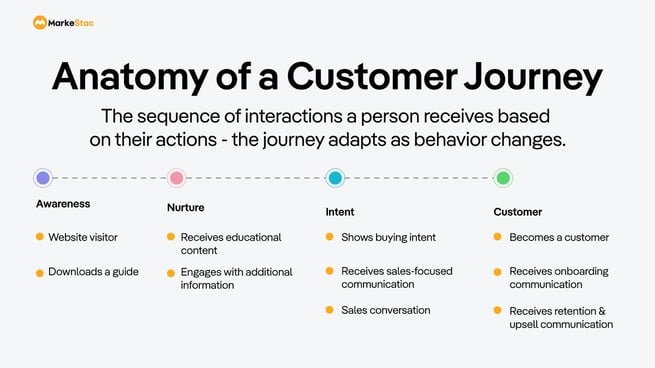
The journey described above can change depending on the customer behavior. Someone who does not engage may receive fewer messages or different content, while someone demonstrating strong intent can move into a more sales-focused journey.
You can also track buyer intent signals through HubSpot’s Marketing Hub and use the HubSpot CMS or Data Hub (as it’s known today) for better targeted marketing. Check our guide on how to utilize the HubSpot CMS for intent based marketing for more details.
5. Measure and Optimize
Your marketing automation tool will track every interaction to show you exactly what’s working and what’s not, so you can constantly improve your results. You can track metrics like email open rates, click-through rates, unsubscribe rates, and direct revenue generated by each workflow.
You can also perform A/B testing to test different subject lines/ email templates to see which brings better results or adjust your lead scoring data.
Let’s now understand how automated marketing works for B2B and B2C businesses.
Marketing Automation for B2B Businesses
B2B marketing often involves multiple decision-makers, longer sales cycles, higher-value transactions, and extensive research before a purchase. That’s why marketing automation has an important role to play in their lead nurturing and sales alignment.
Automated marketing supports B2B businesses through:
Lead Generation
B2B companies can automatically capture leads from website forms, demo requests, content downloads, webinars, events, consultation requests, and newsletter subscriptions. Once captured, these leads can be categorized according to their characteristics and engagement.
Lead Nurturing
Many B2B prospects are not ready to buy immediately. A prospect may first research a problem, compare solutions, evaluate pricing, and discuss the purchase internally. Automated nurturing allows a business to remain relevant throughout this process.
A typical journey could look like:
New Lead → Educational Content → Industry Insights → Case Study → Product Information → Consultation → Sales Opportunity
The objective of this automated sequence is to educate the prospect while gradually increasing their buying intent.
Lead Qualification
Automated processes can evaluate signals such as engagement with content, website activity, company information, product interest, form responses, and communication history.
And use these signals to prioritize leads for sales follow-up.
As not every lead deserves the same level of sales attention, lead qualification helps your sales teams focus their time on prospects with stronger potential.
Account-Based Marketing
For organizations selling to large companies, automated marketing can support account-based marketing strategies. You can create targeted communication for specific companies, industries, departments, decision-makers, or accounts.
Instead of treating every prospect identically, this allows marketing to create a more personalized experience around strategic accounts.

Marketing Automation for B2C Businesses
B2C marketing typically involves larger audiences, shorter buying cycles, frequent transactions, and a greater emphasis on customer experience. Automated marketing helps businesses to communicate with customers throughout their entire lifecycle.
Here’s a list of some common marketing automation workflows for B2C businesses:
Welcome Journeys
When someone becomes a subscriber or customer, an automated welcome journey can introduce the brand and establish a relationship with them.
An example of this automated welcome workflow could be:
Signup → Welcome Message → Brand Introduction → Product Education → Personalized Recommendation
.jpg?width=637&height=262&name=The-Welcome-Journey%20(1).jpg)
This ensures that new customers receive consistent communication from the beginning that keeps them engaged and guides towards conversion.
Abandoned Purchase Recovery
Sometimes, customers show strong buying intent but leave before they complete a purchase. You can use automated communication here to remind them about your products or services that they were considering.
A simple journey could be:
Product Interest → Purchase Not Completed → Reminder → Helpful Information → Follow-up Offer
The purpose of such workflows is to bring the customer back without relying on manual follow-up.
Customer Retention
Marketing automation is not only about acquiring customers. You can utilize automated marketing workflows for retention like post-purchase communication, product education, feedback requests, customer satisfaction campaigns, renewal reminders, loyalty communication, and personalized recommendations.
Keeping existing customers engaged is as important as generating new customers. In many cases, retaining customers proves to be cheaper and more effective.
Automated Marketing across the Customer Lifecycle
One of the biggest advantages of digital marketing automation is the ability to connect marketing activities across the entire customer lifecycle.
A typical lifecycle can include:
Awareness
At this stage the prospects are discovering your business. Automation here focuses on capturing their contact details so you can begin a relationship.
You can use automated workflows like:
- Smart Pop-ups to trigger a personalized lead-capture form based on behavior like when a user scrolls down half of a blog post.
- Instant Asset Delivery to automatically send emails a PDF, checklist, or discount code the exact second a user fills out a registration form.
Consideration
The prospects begin to research solutions at this stage of their journey. You can use marketing automation workflows here to educate them and establish credibility.
You can use automated workflows like:
- Drip Campaigns to send educational emails at scheduled intervals to build trust.
- Behavioural Triggers to move leads into relevant campaigns based on their actions and interests.
Decision
The prospects at this stage are evaluating whether they should make a purchase. You can use automation to help address their needs and guide them toward conversion.
You can use automated workflows for:
- Lead Scoring to identify high-intent prospects based on their engagement and behaviour.
- Sending sales alerts so your sales team is notified when prospects take high-intent actions, such as requesting a demo.
Conversion
The prospect becomes a customer at this stage and automation can help to create a smooth transition from prospect to customer.
You can use automated workflows like:
- Purchase Confirmations - Automatically confirm transactions and provide relevant information.
- Customer Status Updates - Update CRM records and stop irrelevant promotional communications.
Onboarding
Customers begin using your product or service. Automation helps them get value quickly through automated workflows like:
- Welcome Sequences - Send setup guides, tutorials, and other helpful resources.
- Product Education - Deliver relevant tips and training based on customer needs.
Retention
Customers continue using the product or service. Automation can help you to maintain engagement and strengthen their loyalty.
You can use automated workflows like:
- Re-engagement Campaigns - Reach out to customers who have become less active.
- Milestone Messages - Send personalized rewards or messages based on customer milestones.
Expansion
Your customers become eligible for additional products or services at this stage and automation can help them identify and act on these opportunities. Through this stage you can increase the customer lifetime value.
You can use automated workflows like:
- Cross-Sell & Upsell Journeys - Recommend relevant products or services based on previous purchases.
- Replenishment Reminders - Prompt customers to reorder products when they are likely to run out.
This approach turns marketing from a collection of individual campaigns into a connected customer lifecycle.
What Is a Marketing Automation Tool?
A marketing automation tool is a technology platform that helps businesses to design, execute, manage, and measure automated marketing processes. While you can explore platforms like Klaviyo, Mailchimp, and Zapier, platforms like HubSpot offer marketing automation capabilities inside its all-in-one CRM platform.
This allows you to connect everything in one tool and create a single source of truth. These digital marketing automation tools can support activities such as lead capture, customer segmentation, email communication, workflow automation, lead nurturing and qualification, campaign management, and reporting.
The first step to successful automation isn’t choosing the right tool but understanding your business process. Because even if you purchase the most sophisticated tool, with an unclear customer journey you’ll still struggle to generate results.
Digital marketing automation agencies like MarkeStac can help you here by creating a personalized customer journey through automation that matches your business processes. Contact us to discuss your requirements.
How to Build an Effective Automated Marketing Strategy
Marketing automation requires a deep understanding of how your business operates and which processes need automation support. You can approach automation through a structured process outlined below:
.jpg?width=662&height=501&name=Process-of-an-Effective-Automated-Marketing-Strategy%20(1).jpg)
Step 1: Map the Customer Journey
Understand how your customers discover, evaluate, purchase, and continue engaging with your business.
Step 2: Identify Repetitive Processes
Find activities that happen frequently and follow predictable patterns. Automating these would help your marketing team.
Step 3: Define Business Objectives
Decide what automation should achieve for your business. This will help you evaluate how automation’s working for you.
Step 4: Create Customer Segments
Group your audiences according to their characteristics, needs, and behavior for better personalized messaging.
Step 5: Define Triggers
Identify the customer actions that should initiate communication or internal processes.
Step 6: Create Relevant Content
Build content for different stages of the customer journey.
Step 7: Develop Workflows
Connect triggers, conditions, messages, and actions into structured journeys.
Step 8: Measure Results
Monitor metrics such as conversion rate, engagement rate, lead-to-customer rate, customer acquisition cost, revenue generated, customer retention, and customer lifetime value.
Step 9: Continuously Optimize
Analyze performance and improve the customer journey over time.
How AI Is Changing Automated Marketing
Artificial intelligence is making automated marketing increasingly sophisticated. Traditional automation generally follows predefined rules like if X happens then do Y. AI can help businesses to move towards more adaptive experiences by analyzing larger amounts of customer data and identifying patterns.
AI-driven automated marketing can support areas such as:
- Content personalization
- Customer intent analysis
- Predictive lead scoring
- Audience segmentation
- Content recommendations
- Customer behavior analysis
- Campaign optimization
- Conversational experiences
The future of automated marketing is therefore not simply about automating repetitive tasks. It is about using data and intelligence to make better marketing decisions.
The Future of Marketing Automation
Marketing is moving from campaign-based communication toward intelligent, customer-centric journeys. The next generation of automated marketing will increasingly combine: Customer data + behavioral signals + personalization + AI + automation + analytics.
This means businesses will be able to create experiences that respond more intelligently to individual customer needs. For B2B businesses, this can mean better lead qualification, more relevant nurturing, and stronger sales alignment.
For B2C businesses, it can mean more personalized customer experiences, stronger retention, and more relevant product recommendations.
The competitive advantage will not come simply from having a marketing automation tool. It will come from designing better processes and using automation to execute those processes consistently.
Final Thoughts
Marketing automation is fundamentally about creating a smarter and more scalable way to engage your customers. For B2B organizations, it can help manage complex buying journeys, nurture prospects, prioritize opportunities, and align marketing with sales.
For B2C organizations, it can help deliver personalized experiences, increase customer engagement, encourage repeat purchases, and improve retention. But no matter your business type, the most effective digital marketing automation strategy begins with a clear understanding of the customer journey.
When you combine strong processes, accurate data, relevant content, intelligent segmentation, and continuous optimization, automated marketing becomes more than a way to save time. It becomes a strategic system for generating demand, improving customer experiences, and driving sustainable business growth. Get in touch with the MarkeStac team to build tailored marketing automation workflows for your business.
.jpg)





.png?width=80&height=81&name=mail-01%20(1).png)


.svg)




.png?width=410&height=126&name=Group%201000005667%20(1).png)